

Speech Delay in Children: When to Act and How Therapies Help
10 Activities to Boost Your Child’s Brain Development at Home
Health Alliance
March 6, 2026
Child Developmental
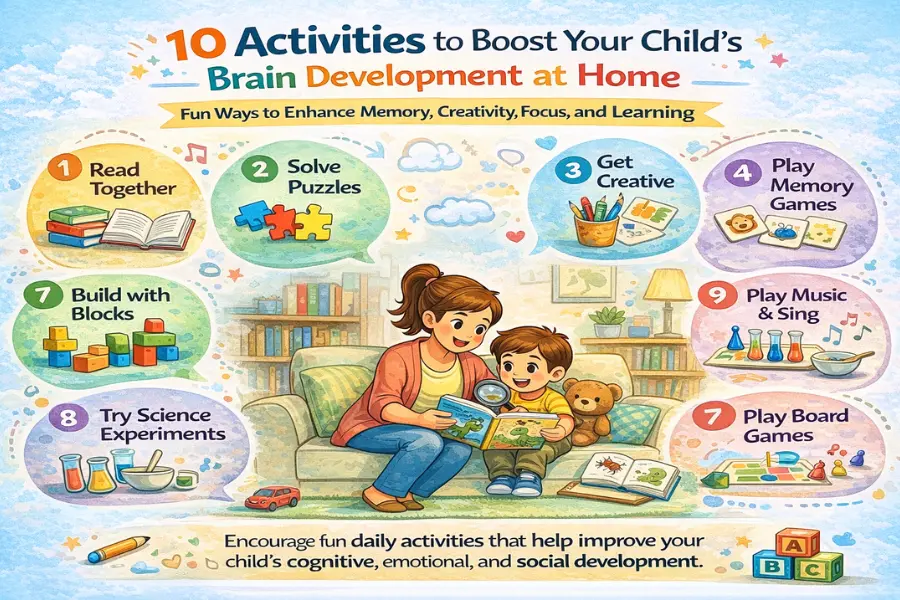
Childhood is a time when the brain forms its architecture through repeated life experiences. Simple everyday activities—done with love and attention—shape neural circuits for language, memory, self-control, and social skills. The suggestions below combine developmental science, practical “how-tos,” and evidence-based reasoning to help you choose activities that fit your child’s age, temperament, and your daily routine. Key sources of science behind these activities include the Center on the Developing Child at Harvard University, guidance from the American Academy of Pediatrics, and the Global Play Resource from UNICEF—as well as sleep, nutrition, and neuroscience reviews.
How to read this list
For each activity you’ll get:
- Why it helps (the brain skills targeted and the science-backed mechanism)
- How to do it (step-by-step, plus age adaptations)
- Practical tips & measurable signs that it’s working.
1) Shared reading — not just words, but conversation
Why it helps: Reading aloud helps children develop vocabulary, sentence structure, and sustained attention. When adults incorporate reading into two-way interactions (labeling pictures, guessing, responding to children’s comments), it strengthens language networks and early literacy. Pediatricians recommend reading aloud from early childhood to promote language and relational health.
How to do it:
- Babies (0–12 month): hold the book, point to pictures, use different voices, name objects. Respond to babbles.
- Toddlers (1–3 yrs): pause and ask “Where’s the dog?” or “What sound does the cow make?” Let them point or answer.
- Preschool (3–5 yrs) and up: ask prediction questions (“What do you think happens next?”), prompt retelling, relate story events to real life.
Tips & signs: Aim for 10–20 minutes daily. Signs it’s working: child begins to imitate words, asks for the same stories, uses new words in play.
2) Play-based problem solving (puzzles, block-building, open-ended construction)
Why it helps: Open-ended play enhances logical reasoning, executive function (working memory, planning), and creativity. When children take tests, fail, and try again, they practice cognitive flexibility—essential for school and life. The Harvard Center emphasizes play as a practice for focus and self-control.
How to do it:
- 6–18 months: nesting cups, soft blocks, cause-and-effect toys.
- 18–36 months: simple puzzles (2–8 pieces), copying small block patterns.
- 3–7 years: increasingly complex puzzles, block cities, timed “build this” games.
- 7+ years: LEGO challenges, coding toys, multi-piece puzzles.
Tips & signs: Avoid “correcting” your child’s mistakes; offer support (“Try turning the piece over”) instead of doing it yourself. Signs of progress: longer play times, better ways of solving problems, fewer tantrums when stuck.
3) Conversational turn-taking & “serve-and-return” interactions
Why it helps: Back-and-forth vocal interactions control attention, build vocabulary, and strengthen social-emotional circuits. The “serve-and-return” model (you respond to the baby’s signals) is one of the most powerful neural builders..
How to do it:
- Say what you do out loud: “I am pouring the milk now.”
- Imitate the baby’s voice and wait for a response.
- When a child says a new word, capitalize it: Child: “Car.” Adult: “Red car! It’s fast.”
Tips & signs: Short, frequent interactions throughout the day (diaper changes, feedings). Signs: Babbling more intentionally, longer back-and-forths, starting to use multi-word sentences.
4) Sensory-rich messy play (water, sand, dough, painting)
Why it helps: Sensory exploration strengthens sensory integration, fine motor control, and scientific thinking about cause and effect. New tactile experiences also enhance curiosity and attention networks. Research shows that new things and different experiences often foster deeper connections.
How to do it:
- Babies: supervised water play in a shallow tub with cups.
- Toddlers: finger-painting, kinetic sand, play-dough.
- Preschool+: kitchen science experiments (vinegar + baking soda), texture hunts.
Tips & signs: Use a tray for easy cleanup, embrace the process, not the product. Working with small scoops, pinching, and manipulating objects improves fine motor skills, which are later used for writing.
5) Movement and rhythm — music, dance, gross-motor games
Why it helps: Physical activity helps improve attention, memory, and executive function; rhythm and music specifically support language and temporal processing. Sleep and exercise can also have an impact on cognitive development.
How to do it:
- Infants: bounce, sway, sing nursery rhymes.
- Toddlers: simple movement games (“Simon Says”, follow-the-leader).
- School-age: dance mixes, organized sports, obstacle courses.
Tips & signs: Aim for at least 30–60 minutes of active play daily. Signs of benefit: better mood, easier bedtime, improved focus during quieter tasks.
6) Cooking and kitchen science — math, sequencing, language
Why it helps: Following a recipe is a real-world exercise in sequencing, measuring, and following instructions—skills linked to math and working memory. Involving children in safe kitchen tasks also boosts executive function and self-efficacy.
How to do it:
- Young kids: washing vegetables, pouring pre-measured ingredients.
- Older kids: measuring, counting, timing, reading recipes.
- Turn it into “why” questions: “Why did the dough get sticky?”
Tips & signs: Use simple step cards for children to follow; success looks like improved following of multi-step instructions and pride in completed tasks.
7) Playdates, pretend play, and social problem-solving
Why it helps: Interacting with peers provides opportunities for negotiation, empathy, role-taking, and conflict resolution—essential for social cognition and emotion regulation. Fantasy play builds theory of mind and abstract thinking.
How to do it:
- Role-play scenarios (“Let’s pretend we’re running a shop”) and give each child a role.
- Teach language for emotions: “I see you’re upset because…”
- After a conflict, coach children to use words and take turns.
Tips & signs: Help instead of controlling; white-flag phrases like “your turn” can help children share. Signs: more teamwork, better sharing, use of emotional words.
8) Brain games & puzzles for older kids (strategy games, memory games)
Why it helps: Strategy games train planning, inhibitory control, and working memory. For older children, handheld puzzles, board games (e.g., memory, chess, Settlers-style strategy), and video games with age-appropriate cognitive challenges can improve these executive functions if used wisely. Harvard research on play suggests that age-appropriate games increase mental flexibility.
How to do it:
- 4–6 yrs: simple memory matching, board games with short rules.
- 7–12 yrs: strategy games, timed math challenges, logic puzzles.
- Encourage metacognition: “What was your plan? What would you do differently?”
Tips & signs: Limit screen time and favor social play or physical puzzles. Signs of growth: better planning, more strategic choices, fewer impulsive moves.
9) Sleep, nutrition and routines — the invisible scaffolding
Why it helps: Good sleep, balanced nutrition (iron, omega-3s, protein, vitamins), and a regular routine are essential for everything from memory development, attention, to emotional regulation. Systematic reviews link sleep quantity and quality to cognitive outcomes in children. Lack of nutrition during sensitive periods can have long-term effects.
How to do it:
- Keep predictable bedtimes and calming pre-sleep routines.
- Prioritize whole foods: healthy fats, iron-rich foods, and fruits/vegetables.
- Avoid heavy meals and screens just before bed.
Tips & signs: Look for consistent mood and ability to concentrate; chronic sleep problems or poor growth warrant pediatric follow-up.
10) Scaffolded challenges — “zone of proximal development” practice
Why it helps: Based on Vygotsky’s idea of zones of proximal development, children learn best when adults provide just enough support (scaffolding) to allow the child to succeed with the support and progress gradually. Scaffolding builds confidence and allows children to perform at a slightly higher level than they would alone.
How to do it:
- See what the child can do on their own, then add a supportive prompt: a model, a hint, or a question.
- Example: If a child can put 4 blocks together, ask, “How can we make it taller without it falling over?” and demonstrate a technique.
- As your ability increases, gradually remove the support..
Tips & signs: Encourage encouragement and provide specific feedback (“I like that you tried a different bass.”) Hint: The child tries a difficult task and uses your suggested methods.
Putting it together: a week of brain-building without stress
You don’t need to do everything every day. A simple weekly rhythm could be:
- Daily: 10–20 min shared reading + 30–60 min active play
- 3× week: a cooking/kitchen activity or sensory messy play
- 2× week: puzzle/strategy game + a short playdate or role-play session
- Nightly: consistent bedtime routine
Small, repeated doses of these experiences add up to robust brain architecture. The science is clear: relationships and consistent, responsive interactions matter more than exotic toys or “brain training” products.
Quick troubleshooting & equity notes
- If a child is reluctant to engage in an activity, consider their interest. New things often spark interest. Let them take the lead sometimes.
- If you’re short on time, micro-interactions (telling a story while getting dressed, a 2-minute puzzle challenge) also help.
- Low-resource tip: Many great learning opportunities come from household items (utensils, spoons, newspapers)—novelty and caregiver attention matter more than expensive toys. Recent studies show that unfamiliar household objects foster exploration and creativity.
Final evidence-based takeaways (short)
- Play and “serve-and-return” interactions are foundational—do them often.
- Reading aloud from infancy supports language, relational health, and later literacy.
- Sleep, nutrition, and physical activity are basic biological requirements for cognitive growth.
- Scaffolded challenges and open-ended play develop executive function and creativity.