

Toilet Training Problems: When to Seek Professional Help
Eye-Hand Coordination Activities for Better Motor Skills at Any Age
Health Alliance
December 15, 2025
Child Developmental
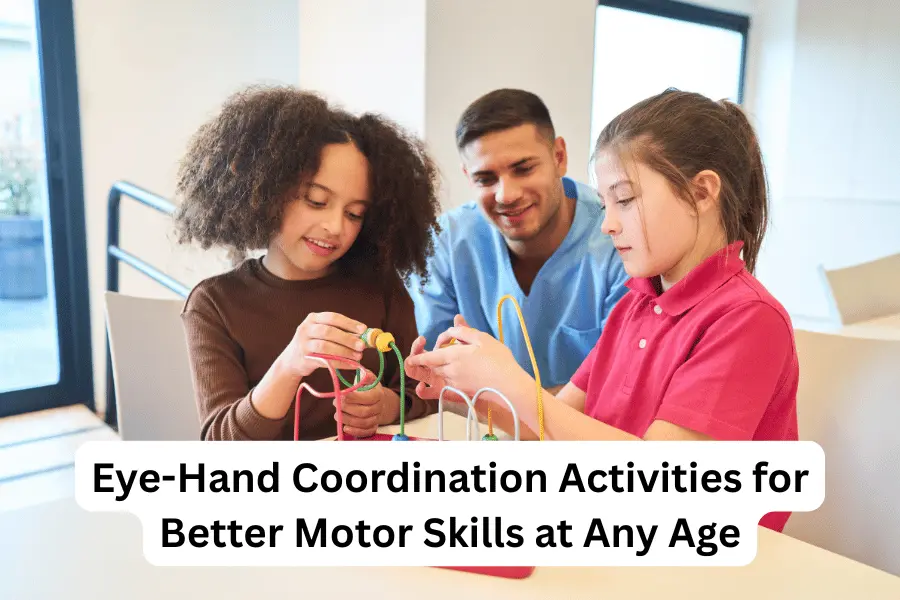
Eye-hand coordination (also known as hand-eye coordination) is the ability to use our vision to guide the movements of our hands. It’s a important motor skill that supports daily life activity we perform — from eating food, writing, playing sports and driving. These skills develop improving through childhood and even into adulthood with practice.
Good eye-hand coordination helps in:
- Fine motor skills like Using scissors, Folding clothes, Typing on a keyboard, Fastening a button, Zipping a zipper, Tying your shoes etc.
- Gross motor skills like Standing, Walking, Running, Chewing, Jumping, Kicking a ball, Swimming etc.
- Academic performance like reading, copying from the board, computer use.
- Independence in daily living like buttoning, tying shoes, using tools.
Problems with hand-eye coordination can lead to developmental coordination disorder, handwriting problems, slowed learning, or decreased confidence. Fortunately, there are many fun and practical activities that can significantly strengthen this skill for people of all ages.
This article helps to know the importance, development stages, and best activities to improve eye-hand coordination in babies, kids, adults, and individuals undergoing rehabilitation.
Why Eye-Hand Coordination Matters
Eye-hand coordination is not just a motor skill. It helps to cognitive improvement like focus, planning, and visual perception. This means improving coordination positively impacts learning, attention, and problem-solving.
Key benefits
Area | How It Helps |
Academic Skills | Handwriting, drawing, and using a computer mouse |
Daily Living | Buttoning shirts, eating with utensils, or pouring water require a well-coordinated connection between the eyes and hands. |
Sports & Fitness | Basketball, baseball, or tennis develop better reflexes, agility, and balance. These skills not only help in sports but also contribute to overall physical health. |
Cognitive Development | Activities that involve coordination help improve concentration, focus, and problem-solving abilities, which are crucial for academic and personal growth. |
Safety & Independence | Greater confidence in physical tasks and reduced risk of injury |
Development of Eye-Hand Coordination by Age Group
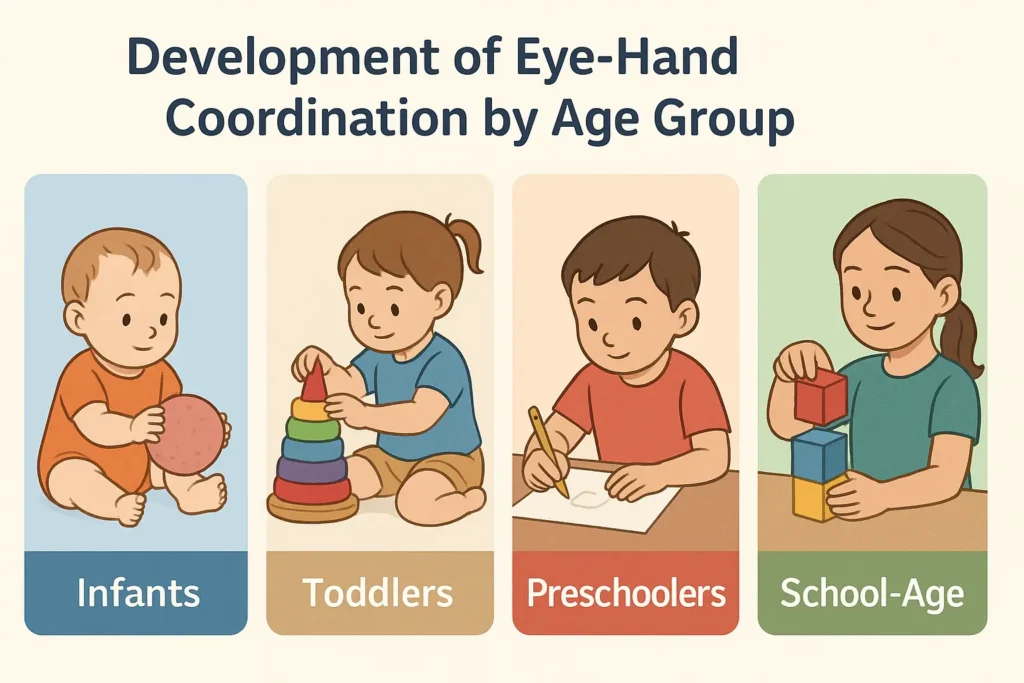
Eye-hand coordination improves as children grow and gain more control over their movements. Here is how it typically progresses:
- For Infants (0–1 year)
Begin reaching for objects, picking up toys, tracking moving objects visually. - Toddlers (1–3 years)
Use both hands to stack blocks, turn pages, eat with utensils and make marks with a pen or pencil that are not letters or pictures. - Preschoolers (3–5 years)
Cut with scissors, draw shapes, catch rolling balls, build complex block structures. - School-age children (6–12 years)
Write fluidly, participate in sports, perform coordinated two-hand tasks. - Teens & Adults
Coordination becomes more precise and sport-specific activities sharpen accuracy. - Older Adults
Coordination can decline slightly but remains trainable through targeted activities.
Understanding this helps caregivers, teachers, coaches, and therapists select age-appropriate activities.
Eye-Hand Coordination Activities for Different Age Groups
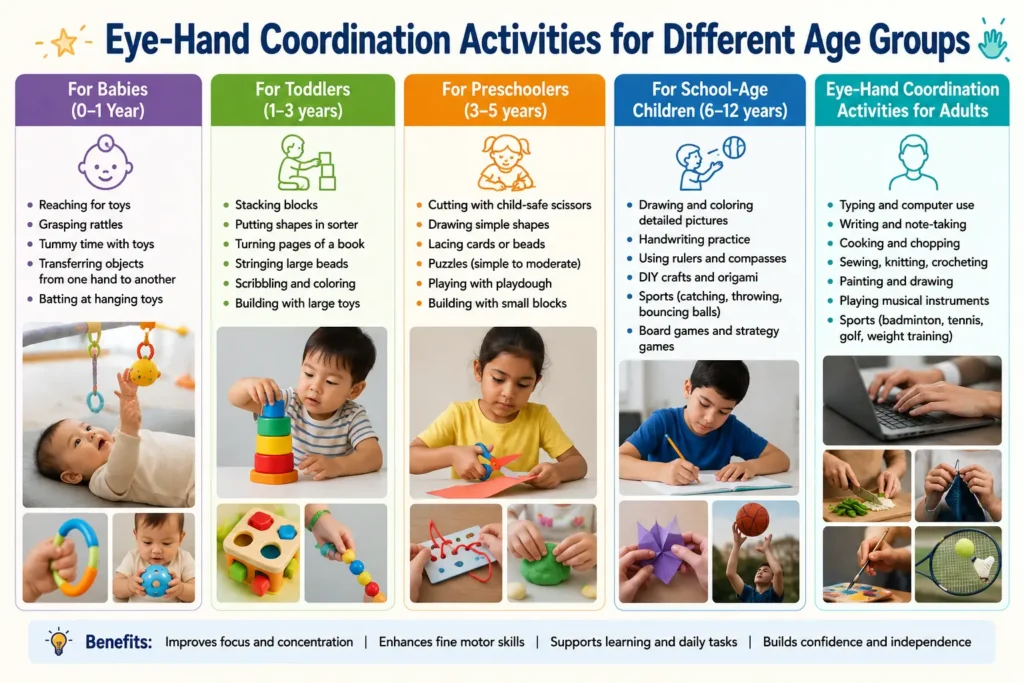
The following activities are designed to be fun, adaptable, and beneficial for development.
For Babies (0–1 Year)
The goal is to encourage reaching, grasping, and tracking:
- Tummy Time Toy Reach
To improve arm strength and visual concentration, keep colorful toys within reach while lying on your stomach. - Rattles and Musical Toys
Encourage babies to shake, grasp, and visually follow moving objects. - Bubble Tracking
Blow bubbles and help babies reach for them — excellent for visual tracking skills. - High-Contrast Flash Cards
Stimulate eye movement and focus while they try to touch or grab images.
For Toddlers (1–3 years)
Fun tasks that build early fine and gross motor abilities:
- Stacking Blocks or Cups
Develop precision, spatial awareness, and problem-solving. - Scribbling and Finger Painting
Strengthens hand muscles and supports pre-writing skills. - Ball Rolling Games
Roll a medium-sized ball back and forth to improve timing and control. - Shape Sorters and Peg Boards
Encourage matching visual cues with hand placement. - Simple Throwing Games
Toss soft balls into baskets from short distances.
For Preschoolers (3–5 years)
Refining control before academic tasks begin:
- Cutting with Safety Scissors
Practice straight and curved lines to build hand stability. - Threading Beads and Lacing Cards
Great for focus, coordination, and strengthening fingers. - Play Dough Manipulation
Squeezing, rolling, and shaping enhance tactile skills and grip. - Balloon Volleyball
Slower-moving balloon gives children time to visually track and respond. - Puzzles
Encourages spatial reasoning, grip control, and visual matching.
For School-Age Children (6–12 years)
More advanced tasks involving strategy, speed, and precision:
- Team Sports: Basketball, cricket, table tennis, badminton
Improve reaction time and physical coordination. - Handwriting & Drawing Practice
Maze books, tracing worksheets, and art projects refine control. - Marble or Coin Games
Require precise finger movement and visual attention. - Video Games with Motion Use (age-appropriate)
Some games enhance visual processing and hand reactions. - DIY Crafts
Origami, gluing pieces, weaving — boost creativity and motor planning.
Eye-Hand Coordination Activities for Adults
Adults benefit from advanced and skill-specific coordination challenges:
- Racket Sports
Tennis, squash, and badminton build rapid visual-motor responses. - Target Sports
Archery, darts, and shooting require precision and focus. - Cooking Tasks
Chopping, stirring, pouring — everyday practice for control. - Driving Simulators & Gaming
Improve visual alertness and split-second decision-making. - Juggling Practice
One of the most beneficial activities for bilateral coordination.
These not only enhance skills but also reduce stress and support cognitive health.
Activities for Seniors or Rehabilitation Patients
Eye-hand coordination is especially important for older adults and those recovering from injuries, strokes, or neurological conditions.
Therapeutic activities include:
- Balloon Tapping
- Beanbag Toss
- Catching Therapy Scarves (light and slow)
- Peg Boards & Large Puzzles
- Domino Arranging
- Squeeze Balls for Grip Strength
- Tracing and Coloring Sheets
These exercises improve:
- Neural pathway recovery
- Dexterity and strength
- Confidence in daily activities
Consistency leads to measurable progress in independence and mobility.
Which Therapy Helps for Hand-Eye Coordination?
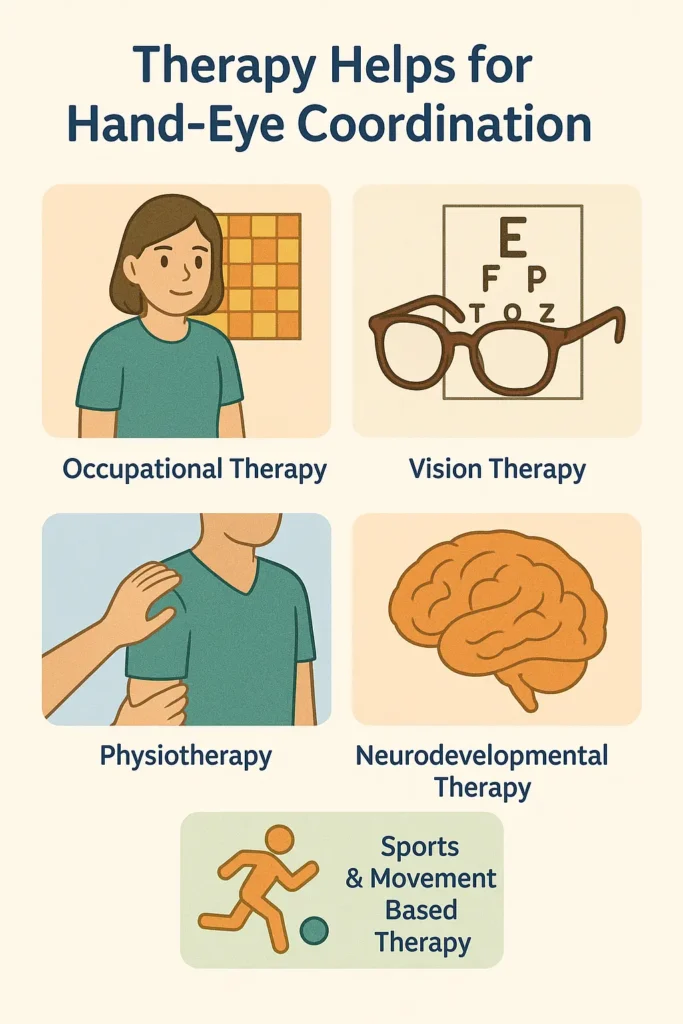
Hand-eye coordination is supported by several therapies. Because it involves motor skills, visual processing, and cognitive planning working together. The right therapy depends on age and the underlying cause (developmental delays, injury, stroke, neurological conditions, etc.).
Here are the most effective therapies that help improve hand-eye coordination:
Occupational Therapy (OT) — The Most Common & Effective
Occupational therapists use structured and fun activities to improve:
- Fine motor skills
- Visual-motor integration
- Sensory processing
- Daily living skills (writing, feeding, dressing)
Typical OT activities include:
- Peg boards, bead threading
- Scissor cutting
- Ball throwing / catching
- Writing and tracing tasks
- Hand strengthening exercises
OT is recommended for:
- Children with developmental delays
- Autism, ADHD, Dyspraxia / DCD
- Stroke or brain injury rehabilitation
Vision Therapy / Visual-Motor Therapy
This helps when coordination issues come from vision difficulties — especially eye tracking and focus problems.
Therapists use:
- Tracking objects
- Focus change drills
- Ball and target games
- Puzzles, copying tasks
Recommended for:
- Convergence insufficiency
- Visual processing disorders
- Reading and copying struggles
Physical Therapy/Physiotherapy (PT)
Focus on posture, strength, and body control — improving gross motor coordination.
Exercises include:
- Balance boards
- Reaction and reach training
- Obstacle courses
- Core strengthening
Helpful for:
- Cerebral palsy
- Developmental delays
- Muscle weakness
Neurodevelopmental Therapy (NDT)
Used especially for children with neurological conditions. It teaches the brain to form better movement patterns.
Improves:
- Arm control
- Reach precision
- Bilateral coordination
- Motor planning
Helpful for:
- Stroke recovery
- Brain injuries
- Cerebral palsy
Sports & Movement-Based Therapy
Many sports naturally train eye-hand coordination:
- Table tennis
- Badminton
- Basketball
- Cricket
- Martial arts
Also includes:
- Juggling
- Ball games
- Reaction drills
Perfect for children who learn best through play and movement.
How to Choose the Right Therapy?
It depends on the underlying difficulty:
Problem | Best Therapy |
Handwriting struggles, clumsiness, poor fine motor skills | |
Trouble tracking objects, copying from board, visual fatigue | Vision Therapy |
Balance issues or weak posture | |
Neurological conditions (stroke, CP, trauma) | OT + PT + NDT combined |
sports performance improvement | Sports therapy or coaching |
A multidisciplinary approach is often the most effective.
When Is a Therapy Evaluation Needed?
Look for signs like:
- Difficulty catching, throwing, or stacking
- Messy handwriting or slow writing
- Poor attention to visual tasks
- Avoiding sports or craft activities
- Dropping objects frequently
- Difficulty copying from board
Early intervention prevents frustration and boosts confidence.
Conclusion
Eye-hand coordination is essential for physical, cognitive, academic, and emotional development. Whether it’s a child learning to write, an adult improving sports skills, or a senior maintaining independence, everyone benefits from regular practice.
By incorporating a variety of fun and practical activities, such as ball games, puzzles, crafts, sports, and therapeutic exercises, people of all ages can strengthen their coordination and confidence. The key is to keep the activities interesting, gradually challenging, and stimulating so that the learner remains motivated to improve.
Developing good eye-hand coordination allows people to perform everyday tasks more easily, participate successfully in studies and sports, and enjoy greater independence in life—a skill worth investing time and effort in.