

Toilet Training Problems: When to Seek Professional Help
W-sitting: Is it harmful? What parents should know
Health Alliance
January 30, 2026
Child Developmental
By Health Alliance – A Complete Growth & Development Clinic
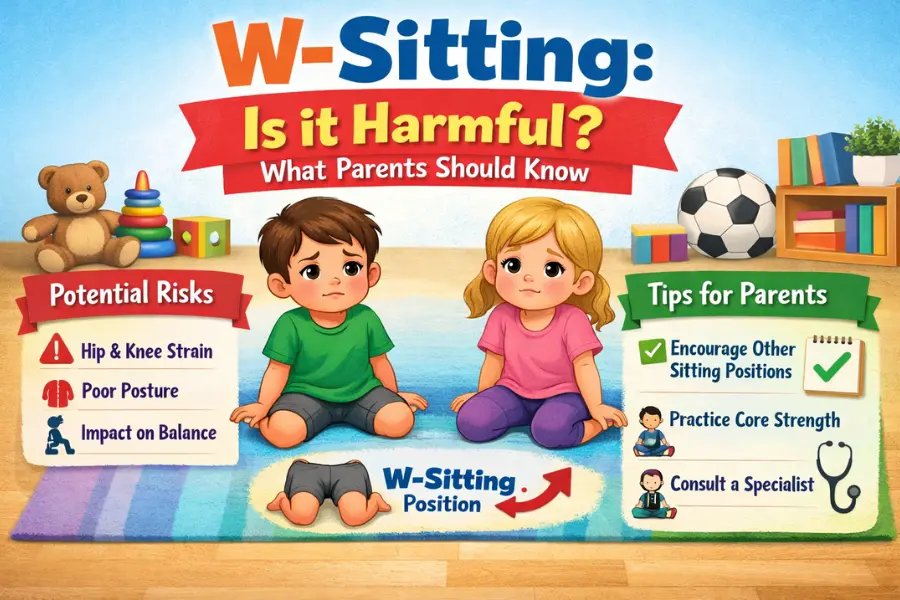
If you’ve ever see your child play on the floor, you may have noticed a very common sitting posture: knees bent, legs turned out to the side, and feet tucked behind—forming a clear “W” shape. This is called W-sitting.
Parents often ask us at Health Alliance: “Is W-sitting bad for my child?”
The short answer is: W-sitting is not always harmful, especially when it happens occasionally. But frequent W-sitting, or when it becomes the child’s preferred way to sit, can sometimes be linked to core weakness, balance issues, tightness in the hips, or motor planning challenges. In some cases, it may also affect posture, coordination, and walking patterns over time.
This detailed guide will help you understand why children W-sit, when to worry, and what you can do at home and when it’s best to consult a pediatric therapist.
What is W-sitting?
W-sitting is a floor-sitting position where a child:
- Sits on their bottom,
- Bends both knees,
- Rotates their hips inward,
- Keeps their legs on either side of their body,
- With feet positioned outside the hips.
From above, the legs resemble the letter W.
Kids often W-sit while:
- Doing puzzles or blocks,
- Coloring or playing with toys,
- Watching cartoons,
- Playing with cars/dolls,
- or during group play in school.
Why do children W-sit?
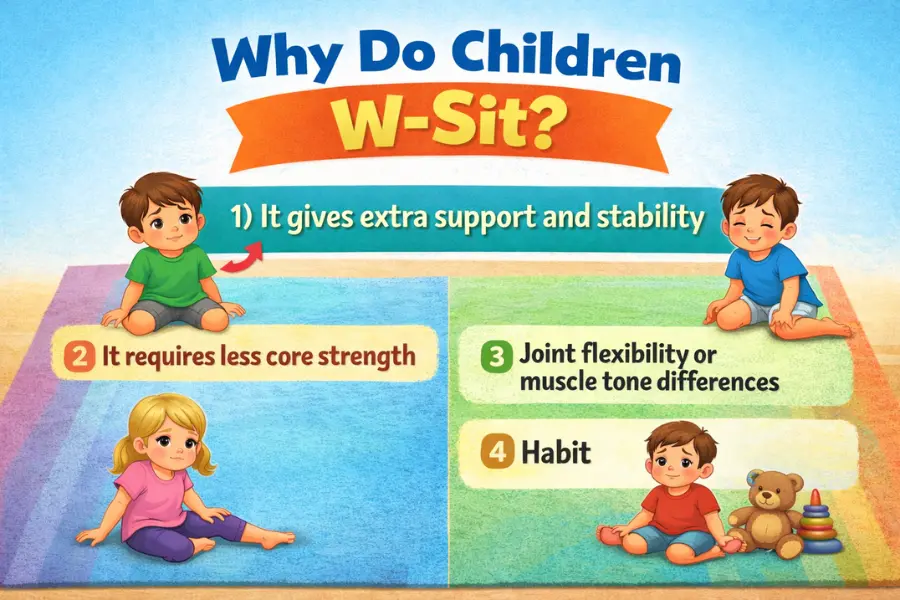
Children don’t W-sit to “misbehave.” They do it because, for many kids, it feels stable and easy.
1) It gives extra support and stability
W-sitting creates a very wide base, helping a child stay upright without needing strong balance reactions. If a child feels “wobbly” while sitting cross-legged, W-sitting may feel safer.
2) It requires less core strength
When a child sits in W, the body doesn’t need to work as hard to maintain posture. Kids with low trunk strength often naturally choose it.
3) Joint flexibility or muscle tone differences
Some children have increased flexibility or a natural hip alignment that makes W-sitting very comfortable. This is common in children with joint hypermobility or differences in muscle tone.
4) Habit
Sometimes W-sitting becomes a habit. If a child frequently sits this way from early toddlerhood, it can become their “default” posture.
Is W-sitting always harmful?
Not always. Occasional W-sitting in a child who has good strength, balance, and can sit in many other positions is usually not a big concern.
The bigger concern is consistent sitting, preferred W-sitting, especially when:
- The child does it most of the time,
- Avoids other sitting positions,
- Looks unstable in other postures,
- or has other developmental concerns.
Think of it like this: it’s not one minute of W-sitting that causes issues—it’s the pattern and the reason behind it.
Why can frequent W-sitting be a problem?
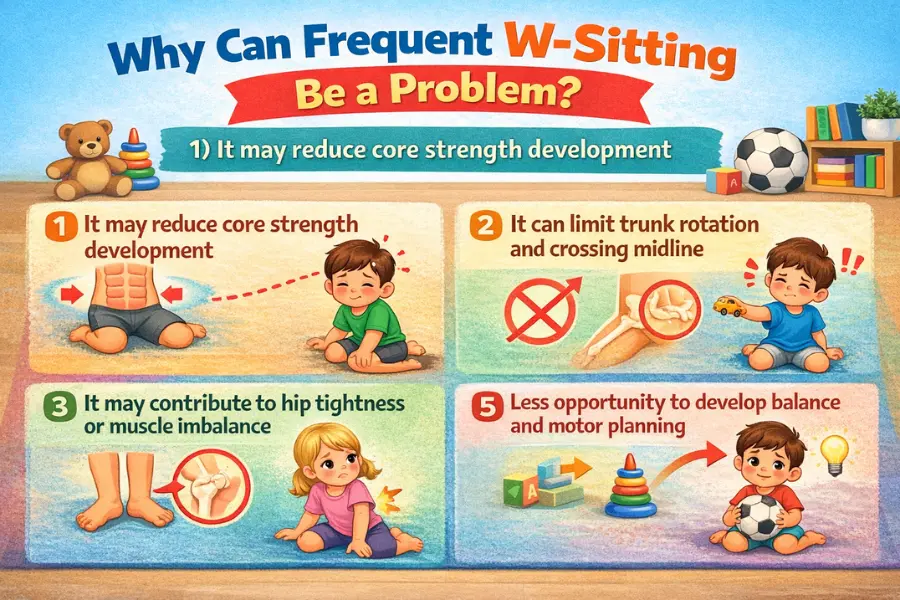
When W-sitting is used as the main sitting position, it may influence how a child’s body develops.
1) It may reduce core strength development
Because W-sitting “locks” the body into a stable base, the child uses fewer trunk muscles. Over time, this can slow development of:
- Posture control,
- Sitting endurance,
- Balance reactions,
- And stability needed for writing and classroom tasks.
A child who relies heavily on W-sitting may show:
- Slouching at the table,
- Fatigue during writing,
- Leaning on one hand while working,
- Poor upright posture while sitting.
2) It can limit trunk rotation and crossing midline
In W-sitting, the hips and legs are positioned in a way that can reduce natural twisting and turning of the trunk. Children may rotate their entire body rather than twisting at the waist. Over time, this may affect:
- “crossing midline” (reaching across the body),
- Bilateral coordination (using both hands together),
- Fine motor skills,
- And early writing readiness.
3) It may contribute to hip tightness or muscle imbalance
Frequent W-sitting may reinforce a movement pattern that favors internal hip rotation. In some children, this can lead to:
- Reduced hip external rotation,
- Tightness around the hips,
- Awkward sitting in other positions.
4) It may reinforce in-toeing in some children
Some children who frequently W-sit also walk with toes pointing inward (in-toeing). W-sitting doesn’t always cause this, but it can reinforce internal rotation patterns.
5) Less opportunity to develop balance and motor planning
If a child uses W-sitting as their main posture, they get fewer chances to strengthen the muscles and coordination needed for:
- Climbing,
- Jumping,
- Hopping,
- Skipping,
- And playground confidence.
When should parents worry? (Red flags)
W-sitting may need professional attention if you notice:
- Your child W-sits most of the time
- They refuse or struggle to sit cross-legged (“criss-cross”)
- They appear clumsy, trip often, or avoid active play
- They have poor posture (slumping/leaning)
- There is toe walking, in-toeing, or unusual walking patterns
- They complain of pain in hips, knees, thighs, or legs
- There are delayed milestones (late crawling, late walking, difficulty jumping)
- The child has known developmental concerns such as Autism, ADHD, motor delay, or low muscle tone
- You observe stiffness or limited movement in the hips or ankles
If you see these signs, a pediatric assessment is a smart next step.
At Health Alliance, our team supports children using:
- Occupational Therapy
- Physiotherapy
- Sensory Integration Therapy
- Neuro-Developmental Therapy (NDT)
- ABA Therapy / Behavior Modification
- Special Education
- Speech Therapy (if motor + feeding/sensory concerns overlap)
What should parents do when they see W-sitting?
1) Avoid scolding or fear-based warnings
Children often don’t realize how they are sitting. The goal is to build awareness, not anxiety.
2) Use gentle reminders
Try short phrases like:
- “Let’s sit criss-cross.”
- “Feet in front.”
- “Try side-sitting.”
- “Pretzel legs!”
Consistency matters more than strictness.
3) Offer better sitting options
Give your child stable alternatives:
Healthy sitting alternatives:
- Cross-legged sitting
- Side sitting (legs to one side)
- Long sitting (legs straight in front)
- Half-kneeling
- Sitting on a small stool/chair at a low table
A simple trick: for drawing or puzzles, use a table + chair. It naturally reduces W-sitting.
Home activities to reduce W-sitting (fun + effective)
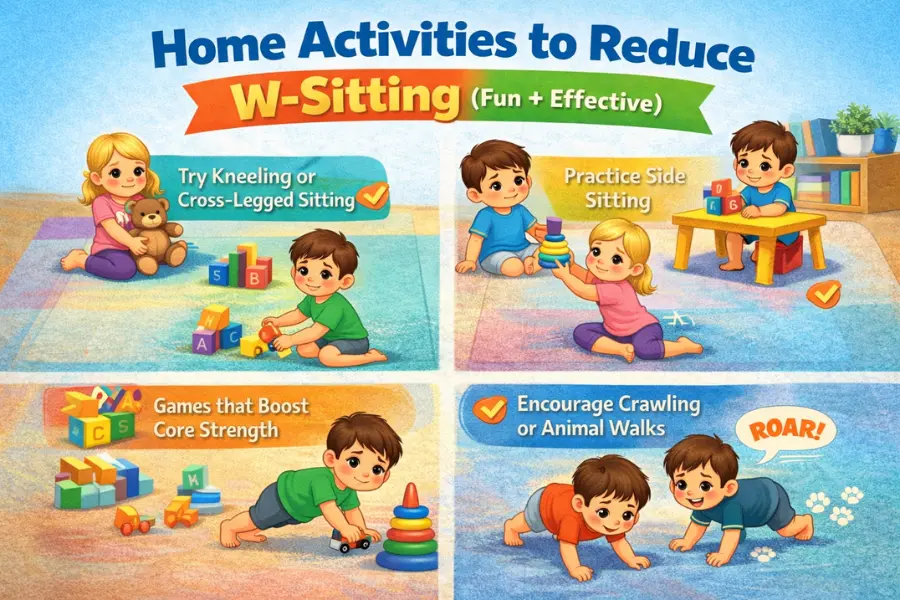
A child often W-sits because they need extra stability. So the best approach is to improve:
- core strength
- balance
- coordination
- hip stability
Here are therapist-approved activities that feel like play:
1) Animal walks (2–5 minutes daily)
- Bear walk
- Crab walk
- Frog jumps
- Bunny hops
These strengthen shoulders, core, hips, and coordination.
2) Obstacle courses at home
Use pillows, cushions, chairs, tunnels:
- crawl under chairs,
- step over pillows,
- balance along a line,
- jump between markers.
3) Wheelbarrow walking
Hold your child at thighs/knees while they walk on hands. Start small.
4) Balance games
- Stand like a flamingo (10 seconds each side)
- Walk on a taped line
- “Freeze dance” with single-leg poses
5) Core play
- Balloon volleyball while sitting cross-legged
- Tug-of-war with a towel
- Crawling races
- Rolling like a log
6) Strength-building sitting games
Encourage play in:
- tall kneeling (knees down, upright body)
- half kneeling
side sitting
Common parent questions
“My child W-sits sometimes. Should I stop it?”
If it’s occasional and your child can easily switch positions, it’s usually fine. Encourage variety.
“Is W-sitting linked to Autism or ADHD?”
W-sitting can be more frequent in children with Autism or ADHD due to differences in muscle tone, balance, sensory processing, or motor planning. But W-sitting alone is not a diagnosis.
“Will my child grow out of it?”
Many children improve as strength and coordination develop. But if it’s persistent and frequent, supporting better posture early is helpful.
When should you consult a therapist?
You should consider a professional assessment if:
- W-sitting is the default posture
- your child is 3 years+ and strongly prefers W-sitting
- there are concerns about balance, walking, frequent falls
- there’s pain, stiffness, or tightness
- there are developmental or behavioral concerns
At Health Alliance, our pediatric therapy team can assess:
- core strength and posture,
- hip range of motion,
- gait and balance,
- sensory processing,
- motor planning,
- and overall developmental milestones.
Based on findings, we create a personalized plan using combinations of:
Occupational Therapy, Physiotherapy, Sensory Integration Therapy, Neuro-Developmental Therapy, ABA Therapy, Behavior Modification, and Special Education support—as needed.
Final takeaway
W-sitting isn’t automatically harmful. It’s common in young children and can be normal when occasional. The concern is when W-sitting becomes a habit, especially if it’s linked with core weakness, balance issues, tightness, in-toeing, or developmental delays.
The best approach is simple:
- Encourage different sitting positions
- Build strength and balance through play
- Seek guidance early if it’s frequent or paired with other concerns
Book an assessment at Health Alliance
Health Alliance – A Complete Growth & Development Clinic
Services: Occupational Therapy | Speech Therapy | Clinical Psychology | Physiotherapy | ABA Therapy | Special Education | Behavior Modification | Sensory Integration Therapy | Neuro-Developmental Therapy | Hypnosis | Autism Therapy | ADHD Management
Branches: Noida | Indirapuram (Ghaziabad) | Rajendra Nagar (Ghaziabad) | Rajnagar (Ghaziabad) | Meerut
- +91-9990967829 | +91-9950840961
- www.healthalliance.in
Led by:
- Dr. Preety Vashisht (PhD, M.O.TH Neurology – Gold Medalist, MAIOTA, Certified Sensory Integration Therapist USA, OPT for Speech & Feeding, MA Clinical Psychology)
- Dr. Puneet Jain (PhD, M.Phil Clinical Psychology RCI, Certified Sensory Integration USA, Certified OPT & Speech Disorder USA, Adv Clinical Hypnosis, Reiki Grand Master)