

Toilet Training Problems: When to Seek Professional Help
How Long Does Speech Therapy Take for a Child?
Health Alliance
September 4, 2026
Child Developmental
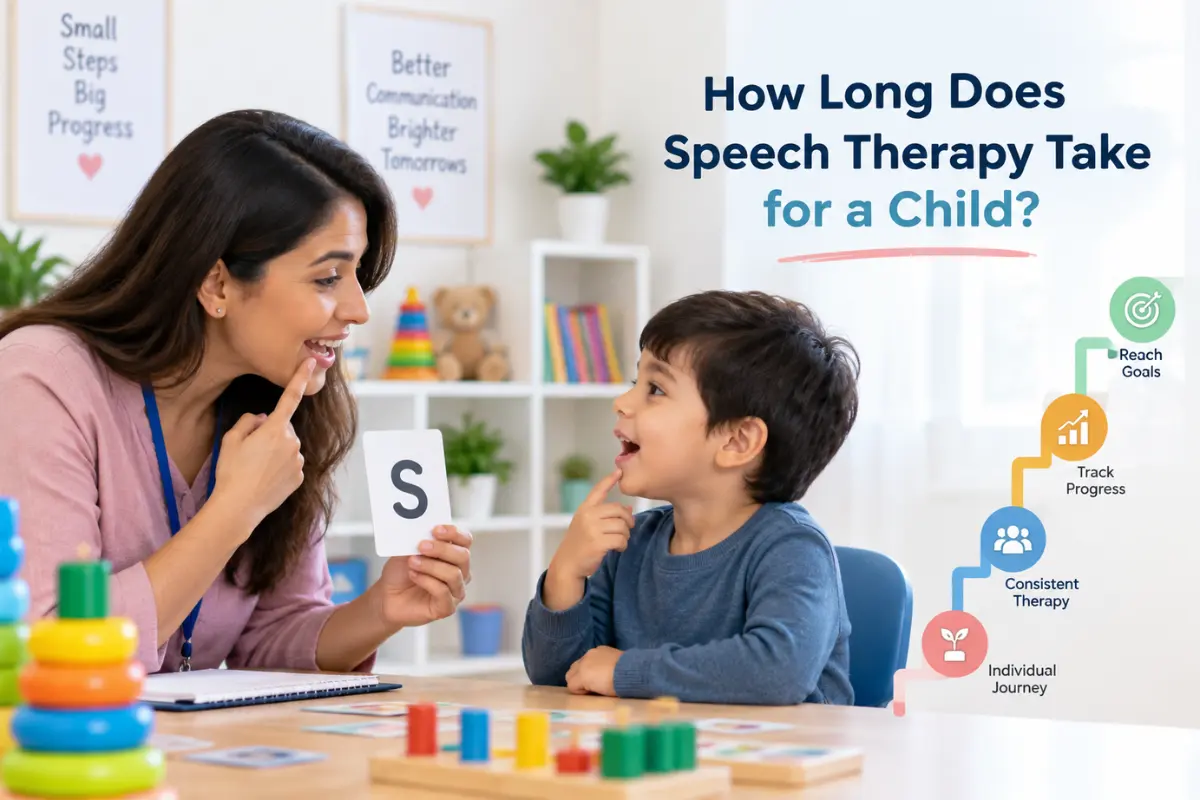
If you’ve just started your child in speech therapy—or you’re considering it—the question on your mind is probably simple: how long is this actually going to take?
The honest answer is that there’s no single number. Most families begin to see noticeable changes within 6 to 12 weeks, but the full course of treatment can run anywhere from a few months to a couple of years, depending on what’s being treated. That range isn’t a dodge—it reflects how differently speech and language challenges show up from child to child.
In this guide, we’ll break down exactly what shapes that timeline, what to expect by condition, and what you can do at home to help your child progress faster.
The Short Answer
For most children, speech therapy runs somewhere between 8 weeks and 2 years, with many families noticing measurable improvement in the first couple of months. Mild articulation issues (trouble with a single sound, for example) often resolve on the shorter end. More complex needs—like apraxia of speech or language delays paired with other developmental differences—typically take longer and may involve therapy that continues for years, with sessions eventually tapering in frequency.
The real answer depends on five factors, which we’ll walk through below.
5 Factors That Determine Your Child's Speech Therapy Timeline
- The Type of Speech or Language Issue
Not all speech challenges are created equal, and the diagnosis matters more than almost anything else.
- Articulation disorders (trouble pronouncing specific sounds) tend to have the shortest timelines, especially if only one or two sounds are affected.
- Language delays (difficulty understanding or using language) often take longer, particularly when they overlap with other developmental needs.
- Apraxia of speech, a motor-planning disorder, usually requires more intensive, longer-term therapy because the brain needs repeated practice to build new speech-motor pathways.
- Stuttering and fluency disorders vary widely—some children respond quickly, while others need ongoing support that ebbs and flows over time.
- Severity
A child with a mild delay in a single area will generally progress faster than a child managing multiple, more severe challenges at once. Severity also affects how therapy is structured—more complex cases often call for a combination of goals worked on simultaneously, which naturally extends the timeline.
- Age
Age plays a bigger role than many parents expect. Younger children’s brains are highly adaptable, and starting therapy early generally leads to faster, more durable progress. Research on articulation therapy specifically shows that the length of time needed to correct sound errors tends to increase the older a child is when therapy begins, with a noticeable shift after age 8. This isn’t a reason to panic if your child started later—therapy still works—but it does mean early intervention is worth prioritizing when possible.
- Frequency of Sessions
Most children attend speech therapy one to three times per week, with session length typically running 30 to 60 minutes depending on age and attention span. Children with more significant needs sometimes attend more frequently, even daily in intensive programs. More frequent sessions can accelerate progress, but frequency has to be balanced against what’s sustainable for your child and your schedule.
- Home Practice and Consistency
This is the factor parents have the most control over—and it matters more than most people realize. Just 10 to 15 minutes of daily reinforcement at home is one of the strongest predictors of faster progress. Therapy sessions introduce and refine skills; home practice is what turns those skills into habits.
Typical Speech Therapy Timelines by Condition
Condition | Typical Duration | Notes |
Mild articulation disorder | 2–6 months | Often resolves quickly, especially with 1–2 sounds involved |
Language delay | 6 months–2 years | Timeline lengthens if paired with other developmental needs |
Apraxia of speech | 1–2+ years | Requires intensive, consistent motor-planning practice |
Stuttering/fluency disorder | Highly variable | Some children see fast gains; others need ongoing, cyclical support |
These are general ranges, not guarantees—your child’s speech-language pathologist (SLP) is the best source for a personalized estimate after an initial evaluation.
What Progress Actually Looks Like Along the Way
It helps to know what “on track” looks like at different stages, so you’re not left wondering whether therapy is working.
- Weeks 1–6: Your child starts recognizing and attempting new sounds or language patterns, often with prompting. Early sessions focus on building rapport and establishing a baseline.
- Months 2–6: Skills become more consistent, and you may start noticing carryover at home—your child using a new sound or phrase without being reminded.
- Months 6+: For more complex conditions, this is typically when bigger structural gains happen—longer sentences, more consistent sound production, or noticeably improved fluency.
If you’re not seeing any movement after several months, that’s worth raising directly with your child’s SLP—not as a sign therapy has failed, but as a cue to revisit the plan.
How to Help Your Child Progress Faster
- Practice daily, even briefly. Ten to fifteen minutes of focused practice woven into everyday routines (mealtime, bath time, car rides) reinforces what happens in sessions.
- Stay consistent with appointments. Skipping sessions or spacing them out irregularly slows momentum.
- Communicate with your SLP. Ask what you should be reinforcing at home each week, and share what you’re noticing.
- Be patient with plateaus. Progress in speech therapy isn’t always linear—short plateaus are normal, especially before a new skill “clicks.”
FAQ's
How long does a single speech therapy session usually last?
- Most sessions run 30 to 60 minutes. Younger children often have shorter, 30-minute sessions built around play-based activities, while older children may work in longer, more structured sessions.
How often should my child go to speech therapy?
- Most children attend one to three sessions per week. Children with more complex or severe needs sometimes attend more frequently, including daily sessions in intensive programs.
Can speech therapy take less than 8 weeks?
- It’s possible for very mild, isolated articulation issues, but most children need at least a couple of months of consistent therapy to build durable, lasting improvement.
Does starting speech therapy later mean it will take longer?
- Often, yes—early intervention tends to shorten treatment timelines. But starting later doesn’t mean therapy won’t work; it may simply require more time and consistency.
How will I know when my child is ready to graduate from therapy?
- Your SLP will track progress against specific, measurable goals. When your child consistently meets those goals across different settings (not just in the therapy room), it’s usually time to discuss reducing frequency or wrapping up.