
Child Not Responding to Name: Autism or Normal Behavior?
How to Identify the First Autistic Signs in Newborns
Health Alliance
May 25, 2026
Child Developmental
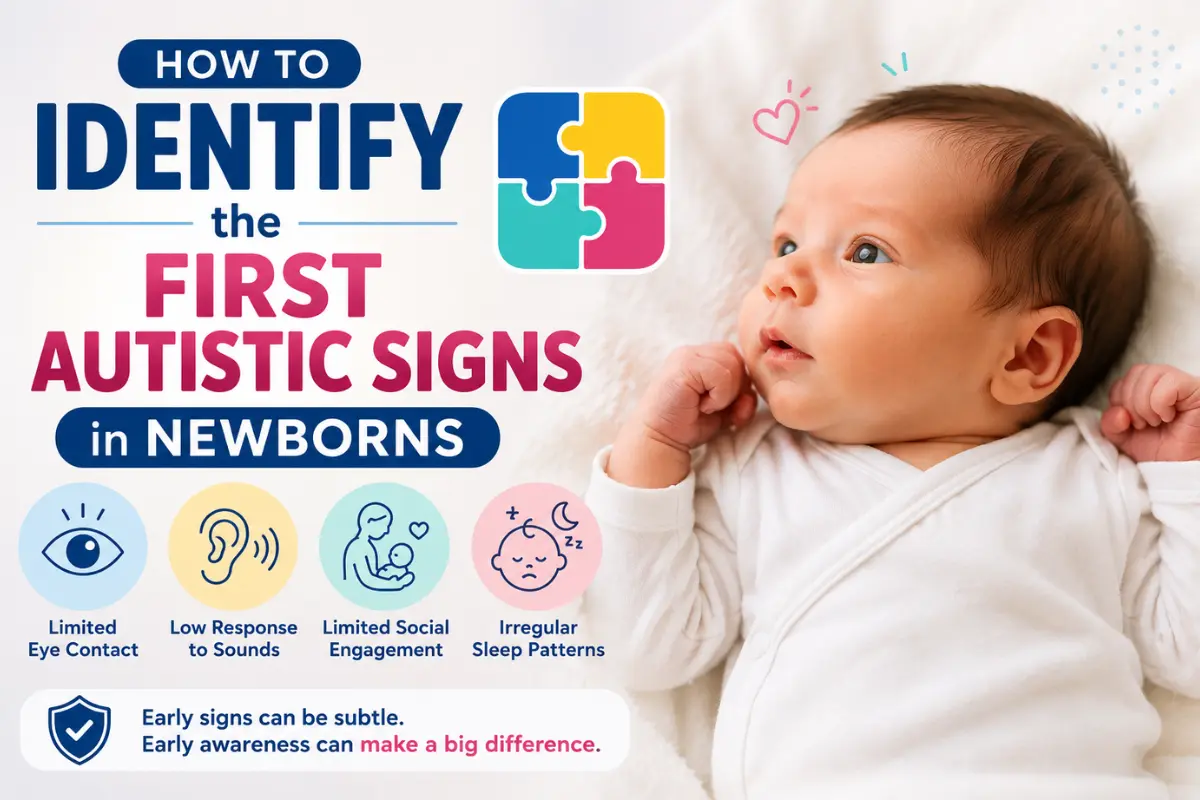
Understanding differences in early childhood development is a subject that many parents naturally ponder. When it comes to Autism Spectrum Disorder (ASD), early awareness can make a significant difference in providing timely support. However, it is essential to begin with a clear and definitive point: autism cannot be definitively diagnosed in newborns. Nevertheless, certain behavioral patterns and developmental differences may begin to emerge during early infancy—differences that often become even more apparent during the first 6 to 12 months.
This article will help you understand what to look out for, what is normal, and when to consider consulting a therapist.
Understanding Autism in Early Life
Autism Spectrum Disorder is a neurodevelopmental condition that affects how a person communicates, interacts socially, and processes the world around them. Symptoms vary widely—hence the word “spectrum.”
In newborns (0–3 months), signs are usually very subtle. Many typical newborn behaviors can overlap with early autism-related differences, which is why observation over time is more important than jumping to conclusions.
Early Developmental Milestones in Newborns
Before identifying differences, it’s important to understand what typical development looks like.
In the first few months, most babies begin to:
- Make brief eye contact
- Respond to loud sounds
- Show interest in faces
- Start smiling (social smile around 6–8 weeks)
- Calm down when comforted by a caregiver
These behaviors form the foundation of social communication.
Early Signs That May Indicate Autism Risk
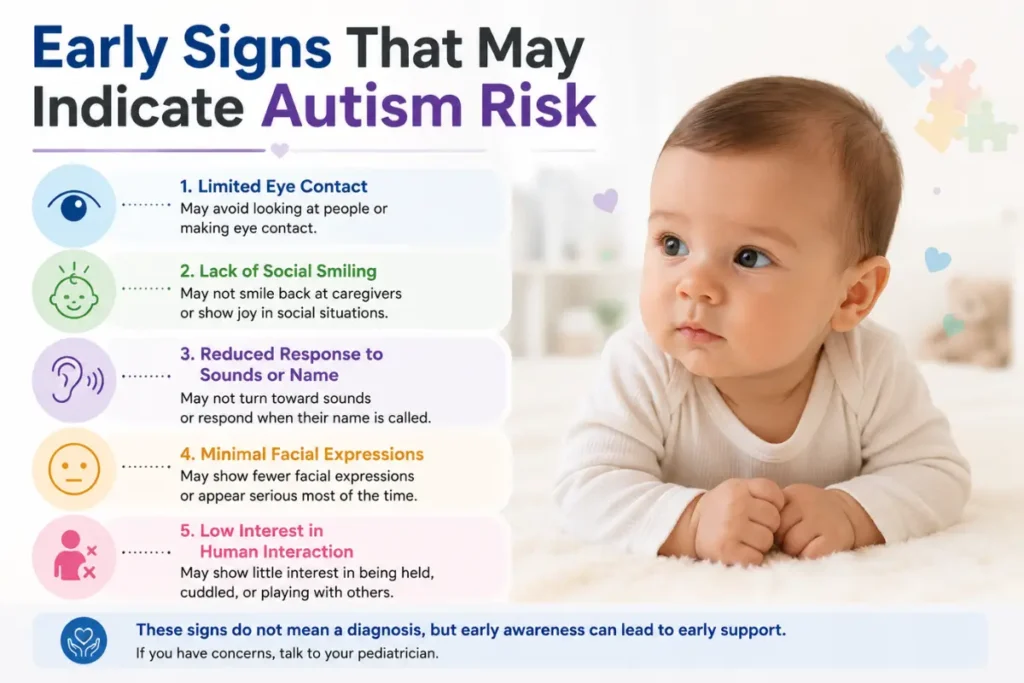
Again, these are not diagnostic signs, but patterns that may warrant closer observation.
Limited Eye Contact
Babies are naturally drawn to faces. If a newborn:
- Rarely looks at faces
- Avoids eye contact during feeding or interaction
It may be an early signal of reduced social engagement.
Lack of Social Smiling
By around 2 months, babies typically begin to smile in response to people.
Possible concern:
- Baby does not smile back when you smile
- Appears emotionally neutral most of the time
Reduced Response to Sounds or Name
While newborn hearing varies, you may notice:
- No reaction to familiar voices
- Lack of calming when hearing parents
- Not startling at loud sounds
Note: Hearing issues should always be ruled out first.
Minimal Facial Expressions
Babies usually show expressions like surprise, discomfort, or pleasure.
Watch for:
- Flat or limited facial reactions
- Difficulty reading baby’s emotions
Low Interest in Human Interaction
A newborn should gradually show interest in caregivers.
Possible early differences:
- Prefers looking at objects over faces
- Seems unusually independent or detached
Behavioral Patterns That May Emerge Early
Repetitive Movements
Although rare in newborns, some early signs include:
- Repeated stiffening of arms or legs
- Unusual body movements without clear reason
Unusual Sensory Responses
Some infants may:
- Overreact to lights, sounds, or touch
- Or show very little reaction to stimuli
Examples:
- Crying excessively at normal sounds
- Not reacting to discomfort as expected
Difficulty with Feeding or Comfort
While feeding challenges are common, in some cases:
- Baby avoids physical closeness
- Seems uncomfortable being held or cuddled
Does not calm easily when soothed
Which sign is not correct?
It’s easy to misinterpret normal newborn behavior as a concern. These alone are not indicators of autism:
- Sleeping a lot (normal for newborns)
- Crying frequently
- Not smiling in the first few weeks
- Irregular feeding patterns
Newborns develop at different speeds, so variation is normal.
When Do Autism Signs Become Clearer?
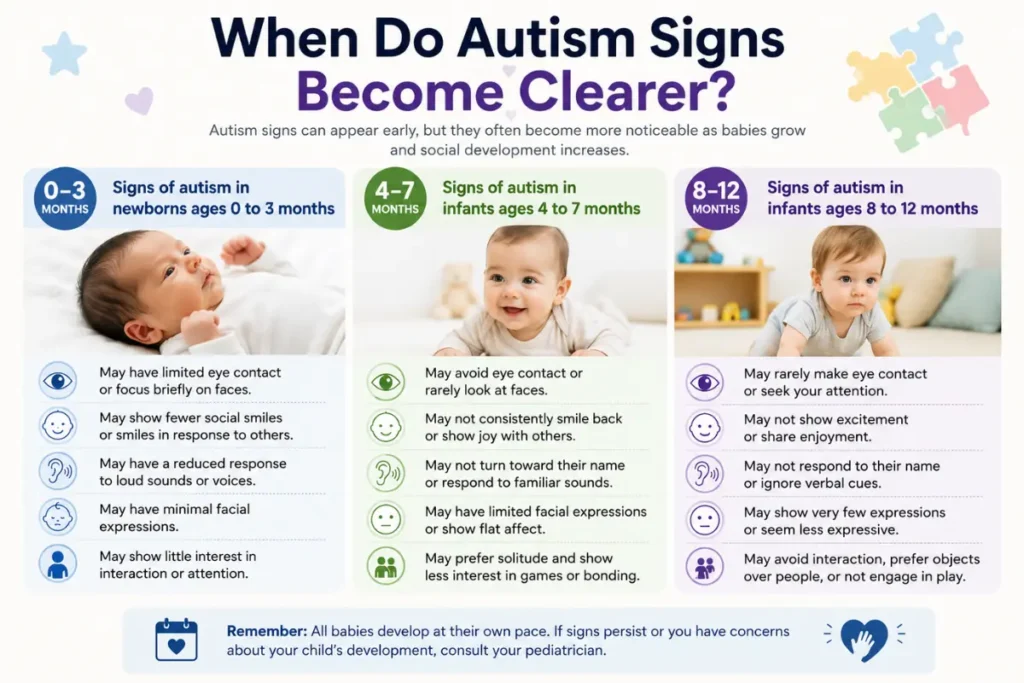
Most noticiable signs of autism appear between 6 to 12 months, not immediately after birth.
Signs of autism in newborns ages 0 to 3 months
Possible early signs of autism in newborns include:
- Not watching moving objects with one’s eyes.
- Sensitivity to loud noises
- Limited facial expression
- Poor facial recognition (especially new faces)
Signs of autism in infants ages 4 to 7 months
Possible signs of autism in babies aged 4 to 7 months include:
- Showing a lack of interest in certain sounds (such as not turning to look to see where the sounds are coming from)
- Perceived lack of affection
- Limited babbling
- Limited verbal expression (like not laughing or making squealing sounds)
- Not reaching for objects
- Not grasping or holding onto objects
- Displaying limited facial expressions and/or emotional responses (such as not smiling spontaneously)
Signs of autism in infants ages 8 to 12 months
Possible signs of autism in older babies aged 8 to 12 months include:
- May not crawl
- May avoid eye contact
- Limited or incomprehensible speech
- May not use gestures such as waving or shaking their head
- May not point to objects or pictures
- May appear unbalanced or unable to stand even when supported3
So, while early observation is helpful, patience and tracking development over time are key.
Risk Factors to Be Aware Of
Some babies may have a higher likelihood of developing autism:
- Family history of autism
- Premature birth
- Low birth weight
- Pregnancy or delivery complications
- Certain genetic or chromosomal conditions
- Being conceived by parents of advanced age
However, many children with autism have no identifiable risk factors.
What Should Parents Do If Concerned?
If you notice consistent patterns that concern you, take practical steps:
- Track Development
Keep a simple record of:
- Eye contact
- Smiling
- Response to sound
- Interaction patterns
- Consult a Pediatrician
Discuss your observations honestly. A doctor may:
- Conduct developmental screening
- Recommend hearing tests
- Suggest early intervention services if needed
- Avoid Self-Diagnosis
Online content can create unnecessary anxiety. Autism diagnosis requires:
- Structured observation
- Developmental assessment
- Professional expertise
Importance of Early Intervention
If autism is identified early, intervention can significantly improve outcomes.
Benefits include:
- Better communication skills
- Improved social interaction
- Reduced behavioral challenges
Early therapy does not “cure” autism, but it helps children develop essential life skills.
Supporting Your Baby’s Development
Whether or not there are concerns, these practices support healthy development:
- Talk and sing to your baby regularly
- Maintain eye contact during feeding
- Engage in face-to-face play
- Respond to your baby’s sounds and expressions
Provide a calm and safe environment
Final Thoughts
Identifying autism in newborns is not about spotting a single sign—it’s about observing patterns over time. Many early behaviors can be subtle, and differences often become clearer as the baby grows.
If something feels off, trust your instincts—but balance that with patience and professional guidance. Early awareness is valuable, but unnecessary worry can also be harmful.
The goal isn’t to label early—it’s to understand, support, and nurture your child’s unique development.