

Child Not Responding to Name: Autism or Normal Behavior?
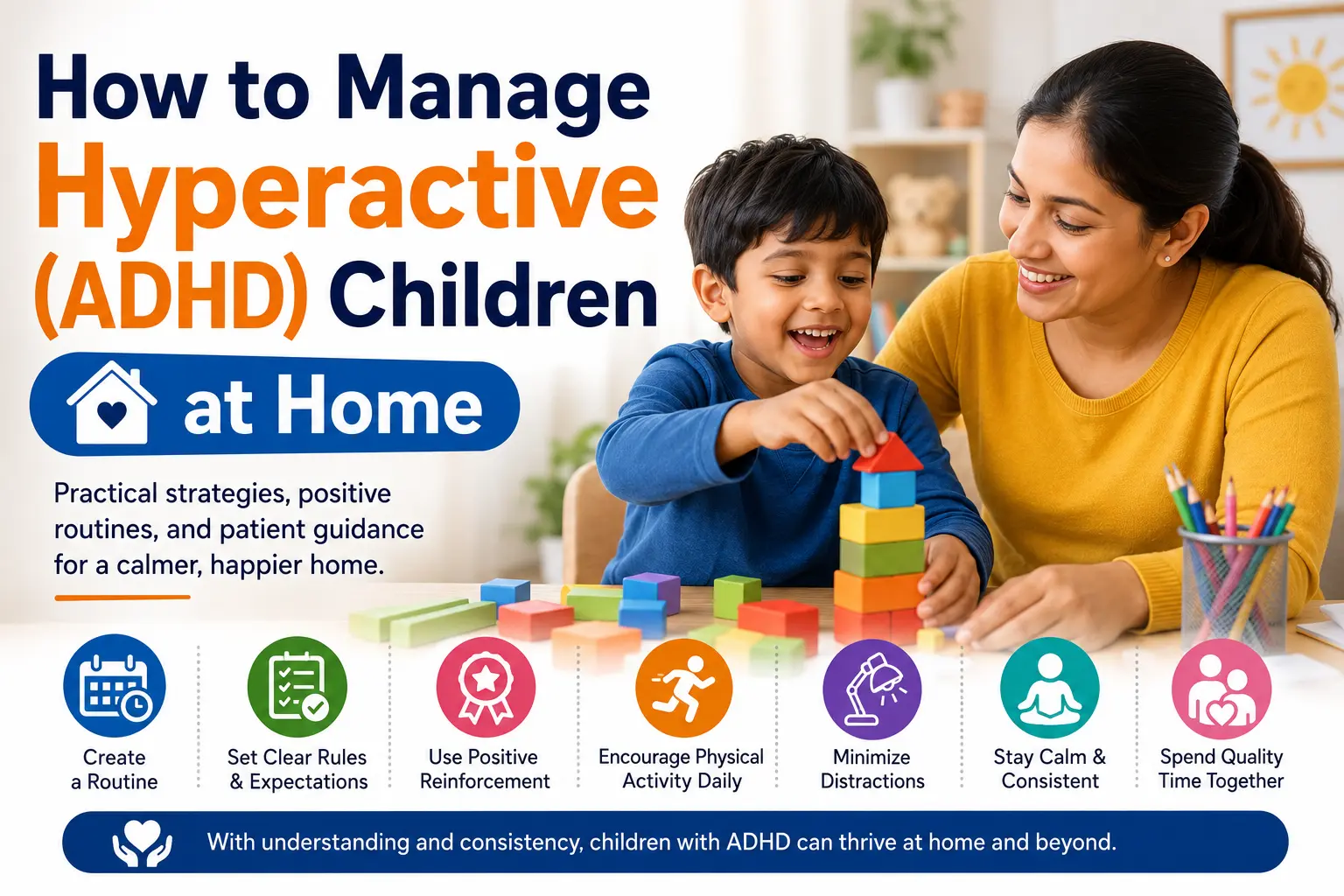
How to Manage Hyperactive (ADHD) Children at Home?
Health Alliance
May 25, 2026
ADHD
“Sit properly.”
“Stop interrupting.”
“Focus on your homework!”
If these are the sentences you repeat all day—and still feel unheard—you’re not alone.
Your child can’t sit still for even a few minutes. They jump from one activity to another, interrupt conversations, forget instructions, and bring home complaints from school like “doesn’t pay attention” or “disturbs the class.” What looks like simple misbehavior to others often feels like a daily battle for you.
And somewhere in between managing all this, a wave of emotions builds up—
- Frustration because nothing seems to work
- Guilt thinking you might be doing something wrong
- Confusion about whether this is just a phase or something more
In many cases, these behaviors are linked to Attention Deficit Hyperactivity Disorder—a condition that affects a child’s ability to focus, control impulses, and regulate energy levels.
But here’s the truth most parents need to hear:
Your child is not “difficult”—they need the right approach.
What is Hyperactivity / ADHD?
Attention-deficit/hyperactivity disorder, or ADHD, is a disorder that impacts brain function. ADHD does not imply a lack of attention, despite being called this. It indicates that you find it more difficult to manage your attention or focus it on particular things. Symptoms of ADHD include impulsive behaviors, difficulty concentration, and difficulty sitting still. However, it also enables you to hyperfocus on things you truly appreciate and “get in the zone.”
ADHD symptoms can last until adulthood and start in childhood, often between the ages of three and six. However, some people wait until they are adults to receive a diagnosis. Although there is no known cure for ADHD, behavioral therapy and medication can help control symptoms.
Approximately 10% of children aged 3 to 17 in the United States have been diagnosed with ADHD. Spend some time learning the facts—and the myths—if your child has ADHD. You can find strategies to support your child by making connections with other parents whose children have ADHD.
Symptoms and Causes
Understanding the symptoms and causes of Attention Deficit Hyperactivity Disorder (ADHD) can help parents move from confusion to clarity—and from frustration to taking the right steps.
The symptoms of ADHD are broadly divided into two main groups, and most children exhibit symptoms from either one or both of these categories.
1. Inattention Symptoms (Difficulty Focusing)
These symptoms affect your child’s ability to concentrate, stay organized, and complete tasks.
You may notice your child:
- Avoids tasks that require long focus (like homework or studying)
- Makes careless mistakes due to lack of attention
- Frequently forgets daily responsibilities
- Gets easily distracted by surroundings—or even their own thoughts
- Has trouble organizing things (school bag, toys, projects)
- Struggles to stay focused while reading or listening
- Often loses important items like books, pencils, or glasses
- Seems “lost” or daydreaming when spoken to directly
- Starts tasks but doesn’t finish them
You may feel like your child is ignoring you—but in reality, they are struggling to maintain attention.
2. Hyperactivity & Impulsivity Symptoms (Too Much Energy + Acting Without Thinking)
These symptoms affect your child’s ability to sit still, wait, and control impulses.
You may notice your child:
- Constant restlessness (movement of hands, feet, or body)
- Getting up when they should stay seated
- Difficulty playing quietly
- Trouble waiting for their turn
- Interrupting conversations or activities
- Jumping into situations without permission
- Running, climbing, or feeling restless all the time
- Acting as if they are ‘always busy
- Talking excessively or finishing others’ sentences
Simple situations—like eating meals, attending school, or visiting relatives—can become stressful and embarrassing.
What Causes ADHD?

One of the biggest misconceptions is that ADHD is caused by parenting style.
That is not true.
- Genetics (Primary Cause)
ADHD is largely genetic, meaning:
- It runs in families
- A parent or sibling may also have similar traits
- Children are born with differences in brain development
- Brain Function Differences
Research shows that in children with ADHD:
- The frontal lobe (responsible for focus, planning, and control) works differently
- It becomes harder to use something called directed attention
Directed Attention = focusing on tasks that are not interesting
Examples:
- Homework
- Chores
- Listening in class
This is why your child struggles with “simple” tasks.
- Executive Function Challenges
Children with ADHD often have difficulty with:
- Planning tasks
- Managing time
- Staying organized
- Completing activities step-by-step
These are called executive functions, and they require mental effort that ADHD brains find exhausting.
- The Flip Side: Hyperfocus (A Hidden Strength)
Here’s something many parents don’t realize:
Children with ADHD can show hyperfocus
This means:
- They can concentrate deeply on things they enjoy
- They may spend hours on games, drawing, or hobbies
- They can develop strong skills in areas of interest
This is not a weakness—it’s a power that can be guided positively.
Practical Strategies to Manage Hyperactive Children at Home
Managing a child with Attention Deficit Hyperactivity Disorder at home doesn’t require perfection—it requires structure, patience, and the right techniques. These strategies are simple, practical, and proven to work when applied consistently.
1. Create a Structured Daily Routine
Children with ADHD feel more secure when they know what to expect.
What to do:
- Fix timings for waking up, meals, study, play, and sleep
- Use a visual schedule (charts or pictures)
- Give a 5–10 minute warning before transitions
2. Break Tasks into Small, Manageable Steps
Big tasks can overwhelm your child and lead to avoidance.
Instead of: “Finish your homework”
Try:
- “Complete question 1”
- “Now take a short break”
- “Let’s do the next part together”
Small task boost confidence and reduce frustration.
3. Use Positive Reinforcement
Children respond better to appreciation than punishment.
Effective methods:
- Praise immediately (“Great job sitting calmly!”)
- Use reward charts or stickers
- Celebrate effort, not just results
Encouragement motivates repetition of good behavior.
4. Encourage Daily Physical Activity
Hyperactive children need a healthy outlet for their energy.
Best activities:
- Outdoor play (running, cycling)
- Sports (football, swimming)
- Dance or martial arts
Physical movement improves focus, mood, and sleep.
5. Limit Screen Time
Too much screen exposure can increase restlessness and reduce attention span.
Guidelines:
- Limit to 1–2 hours per day
- Avoid screens before bedtime
- Replace screen time with creative play
6. Build a Strong Sleep Routine
Good sleep is essential for better behavior and focus.
What helps:
- Fixed bedtime
- Calm pre-sleep activities (reading, soft music)
- No screens at least 1 hour before sleep
Proper rest improves emotional control and attention.
7. Use Calm and Clear Communication
Shouting often worsens behavior instead of improving it.
Better approach:
- Speak calmly
- Use eye contact
- Give short, direct instructions
Example:
“Please sit down and start your homework.”
8. Teach Emotional Control Skills
Children with ADHD often struggle with managing emotions.
Teach them:
- Deep breathing
- Counting to 10 before reacting
- Expressing feelings using words
9. Be Patient and Avoid Comparison
Every child’s journey is different.
Remember:
- Progress takes time
- Comparing with other kids can harm confidence
- Focus on your child’s strengths
When to Seek Professional Help
While strategies adopted at home can make a significant difference, there are times when your child requires additional assistance that goes far beyond what you alone can provide. Recognizing this in a timely manner can help you avoid future difficulties and enable your child to develop better skills.
Signs You Should Not Ignore
Consider seeking professional help if:
- Your child’s behavior is consistent and intense, not occasional
- Symptoms are affecting school performance (poor grades, complaints from teachers)
- Your child struggles to complete even simple daily tasks
- There are frequent emotional outbursts (anger, crying, frustration)
- Social interactions are difficult (trouble making or keeping friends)
- Sleep issues are severe and ongoing
- You feel overwhelmed, exhausted, or unable to manage despite trying different strategies
If these challenges are present for 6 months or more, it’s a strong signal to consult an expert.
Professionals Who Can Help
Different experts play different roles in supporting your child:
- Pediatrician: First point of contact for evaluation and guidance
- Child Psychologist: Helps with behavior, emotions, and coping strategies
- Occupational Therapist: Supports sensory and daily functioning skills
- Behavior Therapist: Works on improving habits and responses
- Neurologist or Psychiatrist: For diagnosis and medical management if needed
Conclusion
Managing a child with Attention Deficit Hyperactivity Disorder is not about controlling every behavior—it’s about understanding your child, adapting your approach, and creating a supportive environment where they can grow.
As you’ve seen throughout this guide , hyperactivity is not a sign of poor parenting or a “difficult child.” It’s a difference in how your child’s brain works. And with the right strategies—like structure, positive reinforcement, patience, and consistency—you can turn daily struggles into manageable routines.
There will be challenging days. Days when homework feels impossible, routines break down, or emotions run high. But there will also be progress—small wins like sitting calmly for a few minutes longer, completing a task, or expressing feelings better.
- Those small wins matter.
- Those small changes build a stronger future.
Most importantly, remember this:
- Your child is not alone—and neither are you
- Progress takes time, not perfection
- Your patience, support, and understanding are the biggest tools your child has
And when needed, seeking professional help is not a weakness—it’s a step toward giving your child the best possible support.