

Toilet Training Problems: When to Seek Professional Help
Child Not Speaking at 2 Years: When to Worry?
Health Alliance
July 3, 2026
Child Developmental
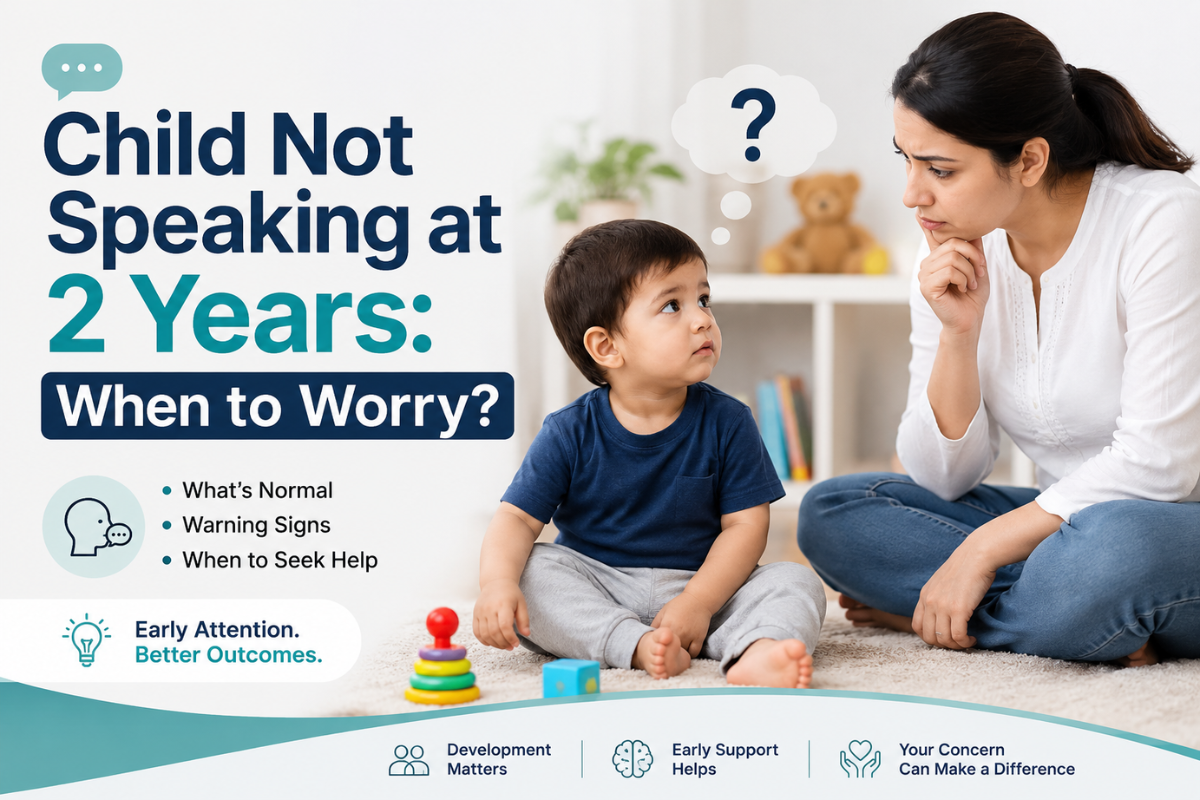
One of the most exciting milestones for parents is hearing their child’s first words. From “Mummy” and “Papa” to short sentences, learning to speak is a crucial part of a child’s development. However, it is natural to worry if your child has turned two and is still not speaking.
Although every child develops at their own pace, a significant delay in speech and language development can indicate a problem requiring professional help. Early identification and timely assistance can make a huge difference in a child’s communication abilities and overall development.
In this article, we will discuss what is considered normal speech development at the age of two, the potential causes of speech delays, the warning signs to look out for, and when to seek professional help.
What Is Normal Speech Development at 2 Years?
By the age of 2 years, most children are expected to:
- Say at least 50 words or more
- Combine two words together (e.g., “more milk,” “mama come”)
- Follow simple commands and understand simple questions.
- Identify familiar people and objects
- Respond to their name
- Use gestures alongside words
- Try to communicate their needs and wants
It’s important to remember that some children may develop speech slightly earlier or later than others. However, if your child is not speaking any words by age 2 or shows very limited communication skills, it may be time for an evaluation.
Speech Delay vs Language Delay
Many parents use the terms speech delay and language delay interchangeably, but they are different.
Speech Delay
Speech refers to how a child produces sounds and words. A child with a speech delay may understand language well but have difficulty pronouncing words or speaking clearly.
Language Delay
Language involves understanding and using words to communicate. A child with a language delay may struggle to understand instructions, express thoughts, or communicate effectively.
How Do Speech and Language Differ?
- Speech is the verbal expression of language and includes articulation (the way we form sounds and words).
- Language is giving and getting information. It’s understanding and being understood through communication — verbal, nonverbal, and written.
Common Reasons Why a 2-Year-Old Is Not Speaking
There are several reasons why a child may not be talking at age 2.
1. Hearing Problems
Children learn to speak by listening to sounds around them. If a child has hearing difficulties, frequent ear infections, or partial hearing loss, speech development can be affected.
Signs may include:
- Not responding when called
- Difficulty following instructions
- Limited reaction to sounds
A hearing assessment is often one of the first steps when evaluating speech delay.
2. Developmental Delays
Some children experience delays in multiple developmental areas, including speech, motor skills, and cognitive development.
These children may also:
- Reach milestones later than expected
- Have difficulty with play skills
- Show challenges in learning new tasks
3. Autism Spectrum Disorder (ASD)
Speech delay can sometimes be associated with Autism Spectrum Disorder.
Additional signs may include:
- Limited eye contact
- Lack of response to name
- Repetitive behaviors
- Reduced interest in social interaction
- Difficulty using gestures such as pointing or waving
Not all children with speech delay have autism, but an evaluation may be recommended if these signs are present.
4. Oral-Motor Difficulties
Some children have difficulty coordinating the muscles of the mouth, lips, tongue, and jaw needed for speech.
These challenges may affect:
- Feeding skills
- Chewing and swallowing
- Sound production
- Speech clarity
Speech therapy can help improve oral-motor coordination.
5. Excessive Screen Time
Research suggests that excessive screen exposure may impact language development, especially when it replaces face-to-face interaction.
Children learn language best through:
- Conversations
- Play
- Reading
- Social interaction
Passive screen viewing does not provide the same opportunities for language learning.
6. Environmental Factors
Limited verbal interaction at home can contribute to delayed speech development.
Children benefit when parents:
- Talk frequently with them
- Read books daily
- Sing songs
- Encourage conversation during daily activities
Warning Signs That Require Attention
While some speech delays are temporary, certain signs should not be ignored.
Consider consulting a professional if your child 2-year-old:
- Does not say any meaningful words
- Uses fewer than 20–50 words
- Does not combine two words together
- Does not respond to their name consistently
- Has difficulty understanding simple instructions
- Rarely makes eye contact
- Does not point, wave, or use gestures
- Shows little interest in interacting with others
- Appears frustrated when trying to communicate
Early evaluation can help identify the cause and guide appropriate intervention.
How Professionals Assess Speech Delay
A comprehensive evaluation may involve multiple specialists, including:
Speech-Language Pathologist
Assesses:
- Speech development
- Language understanding
- Communication skills
- Oral-motor abilities
Occupational Therapist
Evaluates:
- Sensory processing
- Attention
- Play skills
- Fine motor development
Developmental Pediatrician
Reviews:
- Overall developmental milestones
- Medical history
- Behavioral concerns
Audiologist
Performs hearing assessments to rule out hearing loss.
Can a Child Catch Up Without Therapy?
Some late talkers eventually develop speech skills without intervention. However, it can be difficult to predict which children will catch up naturally and which may continue to struggle.
Waiting too long may result in:
- Difficulty communicating needs
- Behavioral frustrations
- Social challenges
- Delayed learning skills
Because the brain develops rapidly during the first few years of life, early intervention provides the best opportunity for improvement.
How Speech Therapy Helps
Speech therapy is one of the most effective treatments for speech and language delays.
A speech therapist works with children to:
- Improve vocabulary
- Encourage word combinations
- Develop communication skills
- Enhance listening and comprehension
- Strengthen oral-motor abilities
- Promote social communication
What Parents Can Do at Home
Parents play a important role in supporting speech development.
Talk Throughout the Day
Describe daily activities, objects, and actions. For example:
- “Let’s wash your hands.”
- “Look at the red ball.”
Read Books Together
Reading exposes children to new vocabulary and language patterns.
Encourage Choices
Offer options such as:
- “Do you want juice or milk?”
- “Blue shirt or red shirt?”
This encourages children to attempt communication.
Limit Screen Time
Prioritize interactive play and conversations over passive screen viewing.
Sing Songs and Rhymes
Music helps children learn sounds, words, and rhythm in language.
Follow Your Child’s Interests
Talk about activities and toys they enjoy to encourage engagement and communication.
When Should You Seek Professional Help?
If your child is 2 years old and not speaking, it is advisable to seek a professional evaluation rather than waiting to see if they “grow out of it.”
Early assessment is particularly important if:
- Your child says very few or no words
- You notice social communication difficulties
- Your child has developmental concerns
- Speech delay is affecting daily communication
The earlier support begins, the greater the chances of achieving positive outcomes.
Final Thoughts
Every child develops at their own pace, but speech and language milestones provide important clues about a child’s development. If your two-year-old is not speaking or has limited communication skills, do not ignore these signs.
A professional assessment can identify potential causes and provide advice on the best next steps. Early intervention through speech therapy, occupational therapy, and developmental support can lead to significant improvements in communication, learning, and social skills.
Remember, seeking help early is not about labeling a child—it’s about giving them the support they need to reach their full potential.
Looking for Expert Support?
If your child is experiencing speech delays or communication challenges, the specialists at Health Alliance – A Complete Growth & Development Clinic can help. Our experienced team provides comprehensive assessments and personalized therapy programs to support your child’s communication and developmental journey.