
Toilet Training Problems: When to Seek Professional Help
Understanding Down Syndrome: A Guide for Parents and Families
Health Alliance
July 26, 2026
Child Developmental
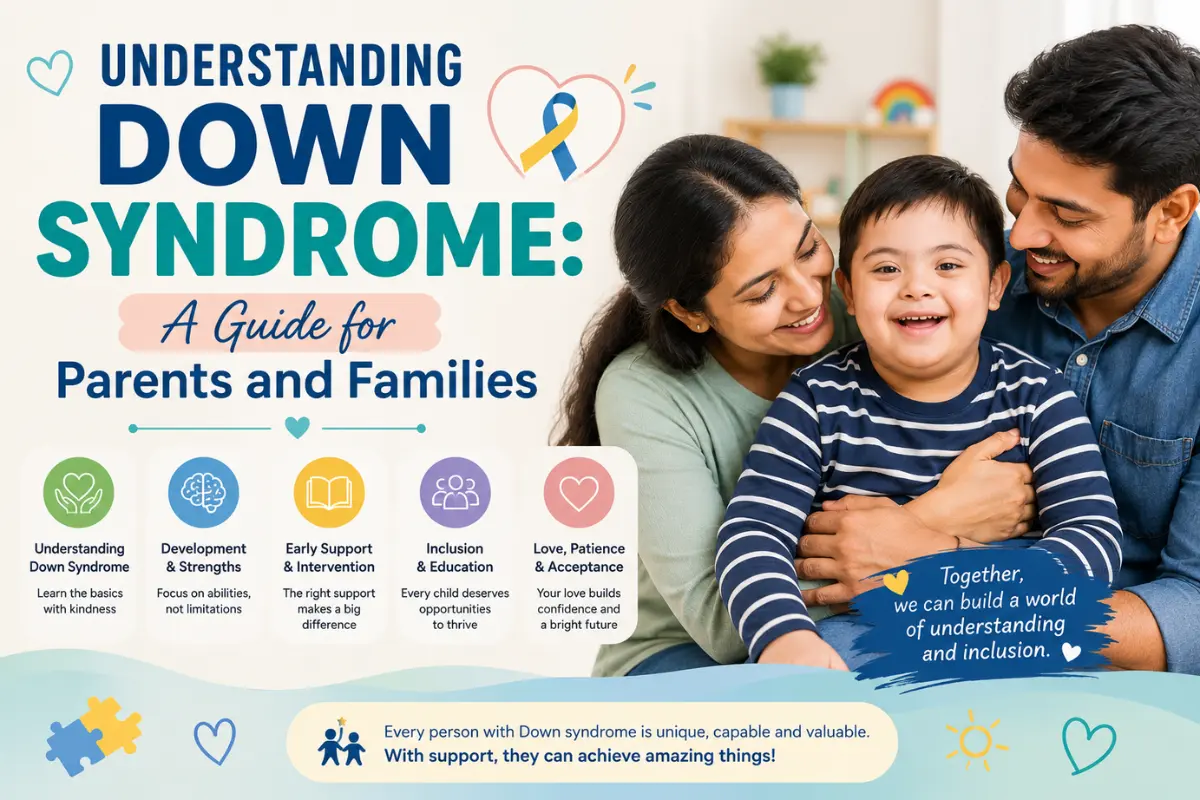
Maybe you just heard the words “Down syndrome” from a doctor for the first time. Maybe you’re expecting a child and processing test results. Or maybe you’re holding your new baby and wondering what comes next. Wherever you’re starting from, one thing is true: you are not alone, and there is a warm, capable community of families who have walked this path before you.
This guide covers the basics — what Down syndrome is, what causes it, the different types, common health considerations, and where to find support. Think of it as a starting point, not the whole story. Your child’s story will be uniquely their own.
What Is Down Syndrome?
Down syndrome is a genetic condition that occurs when a person has a full or partial extra copy of chromosome 21. Typically, humans have 46 chromosomes in each cell — 23 from each parent. In Down syndrome, an extra copy of chromosome 21 changes how the body and brain develop, leading to the physical traits and developmental differences associated with the condition.
It’s the most common chromosomal condition in the United States, affecting roughly 1 in every 640 babies born — about 5,700 babies each year. Down syndrome occurs in people of every race, ethnicity, and economic background, and it’s not caused by anything a parent did or didn’t do during pregnancy. Researchers still don’t fully understand why the extra chromosome occurs, though it’s known that the likelihood increases somewhat with maternal age. Still, because younger women have higher birth rates overall, just over half of babies with Down syndrome are born to mothers under 35.
The Three Types of Down Syndrome
While people often talk about Down syndrome as one condition, there are actually three distinct types, all involving that extra genetic material from chromosome 21:
Trisomy 21 (nondisjunction) is by far the most common type, accounting for about 95% of cases. Here, every cell in the body has three full copies of chromosome 21 instead of the usual two.
Translocation accounts for roughly 3% of cases. The total chromosome count stays at 46, but an extra piece of chromosome 21 has attached itself to a different chromosome, usually chromosome 14.
Mosaicism is the rarest form, making up about 2% of cases. Here, only some of the body’s cells carry the extra chromosome, while others have the typical number. Some research suggests children with mosaic Down syndrome may have somewhat fewer of the condition’s typical characteristics, though individual variation is wide and generalizations aren’t reliable.
Regardless of type, every person with Down syndrome carries that extra critical portion of chromosome 21 — and every person with Down syndrome is, first and foremost, an individual with their own personality, strengths, and interests.
Common Physical and Developmental Traits
No two people with Down syndrome look or develop exactly alike, but some common physical characteristics include low muscle tone, a single deep crease across the palm, an upward slant to the eyes, and smaller stature. Developmentally, most children with Down syndrome experience some degree of intellectual disability, usually in the mild-to-moderate range, along with delays in speech and motor skills.
It’s worth repeating: these are tendencies, not certainties, and definitely not a ceiling. With early intervention — physical therapy, speech therapy, occupational therapy, and inclusive education — children with Down syndrome learn to walk, talk, read, form friendships, and build full, independent lives. Many adults with Down syndrome today hold jobs, live semi-independently, and are active, valued members of their communities.
Health Considerations to Know About
Because the extra genetic material affects development throughout the body, children with Down syndrome have a higher likelihood of certain health conditions. The most common include:
- Congenital heart defects — present in roughly 40–50% of children with Down syndrome, often identified and treated in infancy
- Hearing and vision differences, including frequent ear infections
- Thyroid conditions, which are usually well-managed with monitoring and medication
- Low muscle tone, which physical therapy can meaningfully improve
- Increased risk of childhood leukemia and, later in life, earlier-onset Alzheimer’s disease
- Higher rates of certain autoimmune conditions, such as celiac disease
This list can feel overwhelming at first glance, but context matters: most of these conditions are well understood, actively monitored for, and very treatable with today’s medical care. That’s a major reason life expectancy for people with Down syndrome has risen dramatically — from an average of 25 years in 1983 to around 60 years today. Your child’s pediatrician will likely recommend a specific schedule of screenings (heart, hearing, vision, thyroid) in the early months and years to catch anything early.
Myths Worth Retiring
A few misconceptions still circulate widely, and it helps to name them directly:
- “Down syndrome only affects certain groups.” It occurs across all races and income levels.
- “A Down syndrome diagnosis means a life of hardship.” Many people with Down syndrome describe their lives as happy and fulfilling — and so do their families.
- “People with Down syndrome can’t live independently or hold jobs.” Many do, especially with the growing availability of supported employment and independent-living programs.
- “There’s nothing that can be done.” Early intervention services, inclusive schooling, and modern medical care have transformed outcomes over the past few decades.
Finding Support
You don’t have to figure this out by reading alone. Some good next steps:
- Talk to your pediatrician or a genetic counselor about a personalized care plan and screening schedule.
- Connect with the ‘Down Syndrome Association’ in your area. They typically provide information packets for new parents, organize playgroups, and facilitate meetings with families who have already gone through the same experience.
- Look into early intervention services, often available at low or no cost through state programs for children under three.
- Consider a “new parent” or “first call” support program, many of which pair new parents with an experienced Down syndrome parent for one-on-one conversations.
You’re Not Starting This Alone
A Down syndrome diagnosis often arrives with a flood of questions, and it’s normal to feel a mix of emotions — worry, love, uncertainty, hope, sometimes all at once. What families who’ve been on this journey longer tend to say is this: the diagnosis is just one fact about your child, not the whole picture. Get connected with your local support community, lean on your medical team for the specifics of your child’s health, and give yourself grace as you learn.
If you’re looking for the right support for your child, Health Alliance – A Complete Growth & Development Clinic is here to help. Our experienced team provides comprehensive developmental assessments and evidence-based early intervention services, including Speech Therapy, Occupational Therapy, Sensory Integration Therapy, ABA Therapy, Special Education, and Clinical Psychology. The earlier intervention begins, the better the outcomes for your child’s communication, learning, and overall development. If you have concerns, consult your pediatrician or book an assessment with Health Alliance to get the right guidance and personalized therapy plan. Early intervention has been shown to improve developmental outcomes, especially when started as soon as concerns are identified.