

Toilet Training Problems: When to Seek Professional Help
Echolalia in Children: Why Does My Child Repeat Everything I Say?
Health Alliance
September 4, 2026
Child Developmental
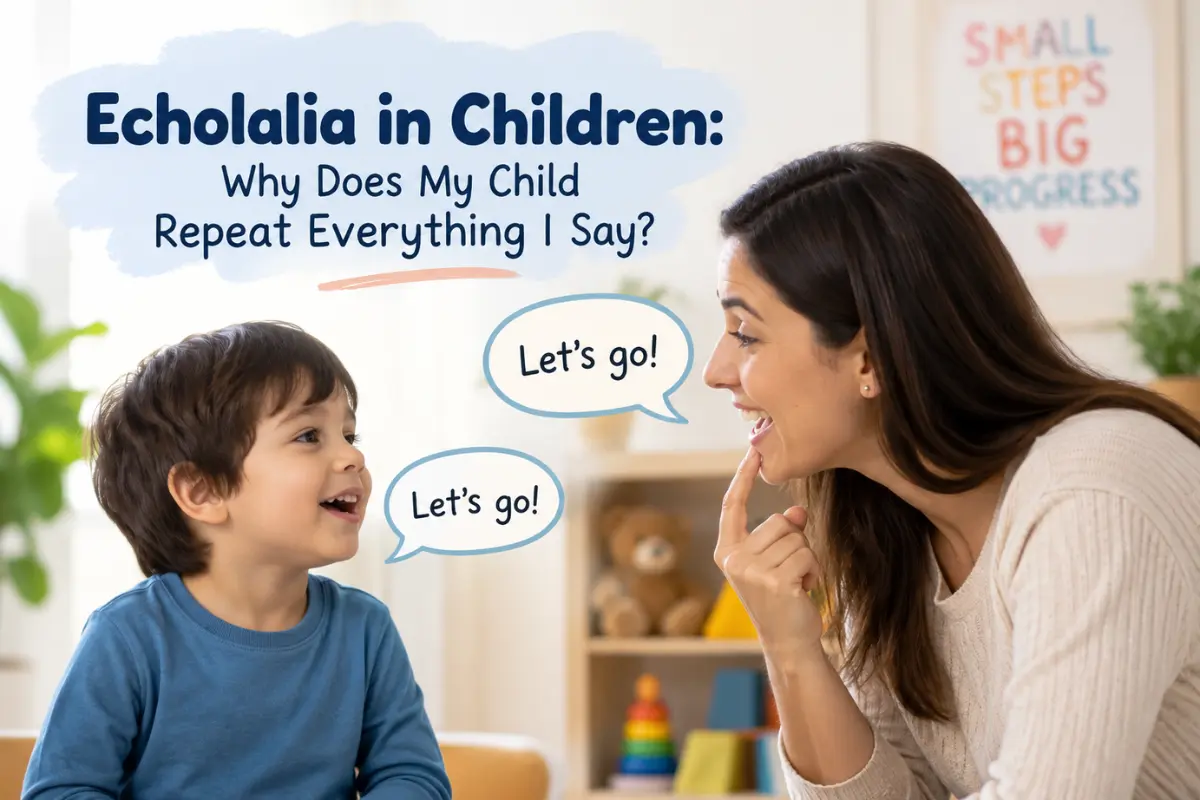
If your toddler answers “Do you want a snack?” with “Want a snack?” instead of “yes,” you’ve witnessed echolalia in action. It can feel puzzling, even worrying, especially if a friend or relative has mentioned it might be linked to autism. Here’s the reassuring truth: repeating speech is one of the most common, and often perfectly normal, stages of learning to talk.
This guide breaks down what echolalia in children actually is, why it happens, how to tell typical repetition from a possible red flag, and what steps to take if you’re concerned.
What Is Echolalia?
Echolalia is the repetition of words, phrases, or sounds a child has heard from someone else, whether that’s a parent, sibling, teacher, or even a cartoon character. The word comes from the Greek roots for “echo” and “speech,” which fits: the child is essentially echoing language back.
There are two main types:
- Immediate echolalia — the child repeats what was just said, within seconds. You ask, “Are you hungry?” and they respond, “Are you hungry?”
- Delayed echolalia — the child repeats a phrase, song lyric, or line from a show hours, days, or even weeks after first hearing it, sometimes in a completely different context.
Both forms are common in early childhood, and both can also appear in children with developmental differences like autism spectrum disorder (ASD).
Is Echolalia Normal in Toddlers?
Yes, in most cases. Echolalia is normal in children roughly 18 months to 3 years old as they learn to speak, and it typically resolves by around age 3 in neurotypical development. Toddlers absorb language the way a sponge absorbs water, and repeating what they hear is one of the ways they practice sentence structure, rhythm, and vocabulary before they can generate original sentences on their own.
Echolalia has been recognized as a normal part of language development in toddlers since it was first documented decades ago. So if your 2-year-old parrots your questions back at you, that’s usually a sign their brain is actively working on language, not a cause for alarm.
Why Do Children Repeat What They Hear?
Repetition serves several real purposes for a developing brain:
- Practicing new sounds and sentence patterns before they can build sentences independently
- Buying processing time — repeating a question can give a child a few extra seconds to understand what was asked and figure out a response
- Expressing a need indirectly, such as repeating “want juice?” to mean “I want juice”
- Self-soothing or engaging with a favorite phrase, especially with delayed echolalia from a beloved show or book
- Connecting socially, by mimicking a caregiver’s tone or turn-taking in conversation
Experts increasingly view echolalia as an effective, adaptive communication strategy rather than meaningless noise, even in children where it persists longer than typical.
Echolalia and Autism: What's the Connection?
Because echolalia is strongly associated with autism in public awareness, many parents jump straight to worry. It’s worth understanding the nuance here.
Echolalia is common and typically improves or resolves by around age 3. A key signal that an underlying condition may be involved is when it continues past that age. Autism spectrum disorder is the most frequent condition associated with persistent echolalia, and roughly three-quarters of people diagnosed with ASD experience it.
That said, echolalia alone is not a diagnosis. It is not exclusive to autism — it’s a normal part of early language development for most children and generally fades as they begin forming their own sentences. Some children with speech or hearing differences, developmental delays unrelated to autism, or even bilingual language exposure may show more repetition than average without being autistic.
Rather than fixating on echolalia by itself, pediatric specialists look at the overall pattern of development, including social engagement, eye contact, play skills, and other communication milestones.
Signs It May Be Time to Seek an Evaluation
Consider talking to your pediatrician or a speech-language pathologist if you notice:
- Repetition persisting well past age 3 rather than tapering off as your child builds original sentences
- Little to no functional language alongside the repeated phrases — for example, they can’t yet ask for things in their own words
- Limited eye contact or reduced interest in social interaction with caregivers or peers
- Repetitive behaviors beyond speech, such as lining up toys, hand-flapping, or strong resistance to routine changes
- Echolalia that seems disconnected from context, with no apparent attempt to communicate
A speech-language pathologist can assess whether the repetition is part of typical development or whether your child would benefit from additional support. Early evaluation doesn’t lock in a label; it simply opens the door to support if support is useful.
How Speech Therapy Can Help
If an evaluation suggests echolalia is interfering with functional communication, speech-language therapy can help a child move from repeating language toward generating their own. Common approaches include:
- Modeling simple, functional phrases the child can adapt to new situations
- Visual supports like picture cards to pair words with meaning
- Encouraging “mitigated” echolalia, where a child starts altering repeated phrases into their own combinations, a documented step toward more flexible language
- Responding to the intent behind the echo, rather than correcting the repetition itself, to reinforce that communication was successful
Therapy plans are typically individualized, since a child using echolalia to request a snack needs a different approach than one using it to self-soothe.
Conclusion
If your child repeats everything you say, take a breath. In the vast majority of cases, this is simply how young children learn to talk, and it fades naturally by around age 3. Keep an eye on the bigger picture: if repetition continues well beyond the toddler years, or shows up alongside other social or developmental differences, a conversation with your pediatrician or a speech-language pathologist is a reasonable, low-pressure next step. Getting an evaluation early gives your child the best shot at whatever support helps them communicate more easily.
FAQ's
At what age should echolalia go away?
- Most neurotypical children stop echoing speech and start forming their own original sentences by around age 3. Some variation is normal, but persistent echolalia past this point is worth mentioning to your pediatrician.
Does echolalia always mean my child is autistic?
- No. Echolalia is a normal, common stage of early language development for most children. It becomes a more meaningful signal only when it persists past the toddler years or appears alongside other developmental differences, such as reduced social engagement or repetitive behaviors.
What’s the difference between immediate and delayed echolalia?
- Immediate echolalia is repeating something within seconds of hearing it. Delayed echolalia is repeating a phrase, script, or song lyric hours, days, or weeks after first hearing it, sometimes in an unrelated situation.
Can echolalia be a good sign?
- Yes. Many specialists now view echolalia as a functional communication strategy rather than empty repetition. It can reflect a child working out language patterns, buying time to process a question, or attempting to connect socially.
Should I correct my child when they echo my words?
- Generally, it’s more helpful to respond to what your child seems to be trying to communicate than to correct the repetition directly. A speech-language pathologist can offer strategies tailored to your child’s specific pattern of echolalia.